(If a picture is worth 1000 words, a regular computer must be worth at least 5.5 netbooks. I definitely use my computer much more often than my netbook. It's easier to type on, faster, and just plain prettier. Really, the only thing my trusty but slow netbook has over my beloved laptop is an SD slot. And that, dear readers, is only important when one is meaning to create a picture post. Say, in order to introduce one's blog audience to one's new home. I'm afraid it hasn't happened yet. But: what kind of writer would I be if I relied solely on pictures to give you an image of the place? Let's see what I can do to paint one first. The actual photos will come later.)
So, you're a traveler arriving to Palencia on the bus. You arrive in the station, grab your bag, and walk out into the late-September sunlight. You're on a non-descript street with a park on the other side, a dusty and much-used children's climbing structure in the center. You're not sure what direction to go and ask a couple of bored-looking teenagers, who point toward a round-about.
At the roundabout, things start to get interesting. There's a shoe store whose window is stacked with knee-high boots, a pizza place, a typical Spanish bar with metal countertop and stools. Even at this time in the afternoon, when the streets are empty, there are people there reading the 'Diario Palentino' and drinking hot, sweet espresso out of tiny cups. You walk past a shuttered bakery whose window is piled high with glossy truffles, fluffy cakes, and cookies packed with nuts and chunks of chocolate. Mental note: come visit later.
At the other end of the intersection you pass onto Calle Mayor, the nervous system of the city, a narrow stone pedestrian street that makes up most of Palencia's downtown. Beautiful old buildings in various archetectural styles and soft colors rise on both sides, most supported by columns that form a colonade for walking underneath. At first, the Calle Mayor resembles an outdoor mall--and in many ways it is. Flashy fashion boutiques crowd one after another, jockeying for space with banks and cell phone stores. But start to look carefully, and you can find almost everything you need here. A bakery, wafting the scent of new cookies into the street; Pilar's Imprenta for all your stationery needs; an electronics store; a supermarket; a coffee shop. This side of the Calle Mayor is particularly architecturally stunning. The Provincial Office is here, with a spun sugar spire; an old university facade looks like a Venetian Palace. On one side a brief passage leads to the Plaza Mayor, or town square, a small but bustling stone plaza where children play in the evenings on the statue in the center. On the other is a street that opens toward the cathedral, whose pinions are topped in those same evenings with a flock of storks and whose grandeur is surrounded by one of the town's only true plazas, filled with trees and open-air cafes.
You reach the halfway point. Calle Mayor is bisected by Calle Cestilla, a bustling automobile throughway. If you turn right here, you can find the striking coral city hall, topped by white icing flourishes. You'll find the city's theaters here, too, and the green cast iron Mercado de Abastos, filled with butchers and produce stands. But you keep going straight, and the pedestrian street continues.
A grand casino with turn-of-the-century architecture serves famously delicious meals on one side of the street, a laundromat and fabric store shore up more fashionable shops on the other. In a few moments, you can see 'La Gorda,' the smooth soapstone sculpture of a woman that marks the street's only fork. Walk to the right and you'd eventually find yourself on the banks of the Pisuerga river, with its assortment of stone and metal bridges arching over the green water, ducks swimming underneath and branches trailing in the current. But you choose to walk to the left, and the end of the Calle appears. You've reached the Parque Salon, an expanse of manicured trees and flowers that features children riding merry-go-rounds in the evening and whose benches fill with the elderly as the sun goes down.
Past the Parque, continuing north, the town changes. To the south, the city has an old, classic feel. Now, you are in modern neighborhoods, apartment buildings whose first floors are packed with bars and shops. The Plaza España welcomes you with a fountain and a scattering of cafes. Soon after you pass the boxy Escuela de Idiomas, where students of all ages study German, English, French, Italian. You see busy playgrounds set with spindly trees and clusters of churches in brick, concrete, sandstone.
Walk far enough and you will pass the rusty red brick walls of the Fabrica de Armas, a working gun factory. Keep going: now there are car dealerships, industrial warehouses, a giant mall, a hospital and famous nursing school. If you had enough time, you could walk all the way to the edge of town and into the hills--and from there you could see the whole town, the neighborhoods dissolving into the plains beyond, and a giant statue of Jesus Christ (called the Otero here), watching over everything.
Thursday, October 13, 2011

Thursday, October 6, 2011
El Pobre Pato
Every journey to a new life is difficult, but not every one inspires you to teach your friend the American internet slang phrase “FML.”
Let’s start from the beginning:
It’s a sunny early-fall day in Berlin. I’ve spent the whole morning showering, packing, preparing for the final final legs of my trek to Palencia. A little bit later than we agreed, Toni arrives to have a quick lunch with me and accompany me to the airport. I’m jumpy and anxious about the impending flight, train/bus connection (I haven’t decided which yet), and final late-night arrival in a new and completely foreign place. I can't stomach any food right now-- I take my pizza to go.
We lug my two giant 20-kilo suitcases to the bus stop (the Iceland Express flight included two free checked bags, and I thought I’d take advantage of the opportunity to get most of my stuff across the ocean in one go.) As we do, we see the bus pull away. There isn't another one for twenty minutes, and there's still a train connection to get to the airport after that. We contemplate a taxi, but Toni decrees that we can make it. I am yet more jumpy. The bus finally comes, packed with people who stare at us and our outsized luggage.
At the station, we run flat out and make the airport train with 15 seconds to spare. It is at this point that I teach Toni the phrase “FML.” Oh, Alissa-on-the-train-to-Schoenefeld. If only you knew what was coming.
We arrive at the airport and find the EasyJet counter. Okay, I think, this could work, right? There’s still 20 minutes left to check in. We’ve made it. I hand my passport to the EasyJet woman.
Except: the small print. I bought a second checked bag, yes. But I didn't realize that the airline’s policy is that all bags cannot weigh more than 20 kilos together... not 20 kilos each, separately. EasyJet Woman informs me coldly that I can check this bag if I like—it will cost E42 per kilo. I do some quick calculations and then reach for the spare E800 I always keep in my back pocket.
Just kidding! I dissolve into a puddle of tears on the floor.
Just kidding, again! But barely. Toni is far more level-headed than I am. He uses his stellar German to ask the EasyJet Bitch (I’ve switched her name in my head at this point) if there’s a post office in the nearby. Miracle of miracles, there’s a DHL desk in the same terminal just a few feet away.
After some semi-panicked shifting of things from one suitcase to another, EJB checks me in. Then Toni uses that same stellar German to get me a quote from the nice ladies at the DHL desk--- only E42 to ship to Spain. We dither for a moment: where to send it? I don’t have an address yet.
Toni, the paragon of cool and calm through all of this, is starting to get agitated. Check in time is over and they have already started boarding the plane. Panicked, we part without a goodbye. I tear my belt and shoes off, take all my electronics out of my backpack, manhandle my bags onto the conveyor belt, sweating all the while. Toni mouths my gate to me through the window.
I run—RUN—to the gate, through a duty-free mall, up and down several sets of stairs, down a long hall. At the gate, there are exactly two idle neon-vested airport security guards and exactly no passengers. I show them the half of my boarding pass that remains, the other having fled the scene sometime during the preceding chaos, and they talk briefly among themselves. Then one of them says to me, “No, not gate 50. Gate 15!”
I don’t have the energy to run back up and down the stairs, back through the duty free mall, and to the other end of the terminal. Panic is flooding white-hot through my whole body at this point, and my breath is coming fast.
I get to Gate 20 and can’t find any lower numbers. Finally, I find a tiny sign pointing around a corner. Another set of stairs; another long hallway. Then a long line in which I catch my breath. The flight is due to take off in 15 minutes. I'm lucky they haven't shut the door yet.
There are two signs above us for gates 16 and 15. Then I hear someone talking about arriving in Amsterdam. I ask my linemates; yes, this is gate 16. I run ahead to the end of the hall: it’s a dead end. I can’t help it. “You’ve got to be fucking kidding me,” I say out loud. The Amsterdam travelers gape at the crazy lady pacing back and forth at the end of the hall, clutching a black traveling bag under her jacket and trying to make it look like part of her clothing in case somebody asks why she has two carry-ons instead of one.
Finally I discover the secret: another staircase down onto the tarmac. I make a mad dash, this time basically in tears. More neon-vested airport workers greet me, comfort me. No, you didn’t miss your flight. Just get in line, miss. I breathe a sigh of relief. (Again, too early.)
I find a seat. There’s no room in the overhead compartments and I have to gatecheck my backpack and take my computer and netbook with me. I’m sitting next to a nice couple from Madrid. For the first time, I’m surrounded by Spanish—I dont’ think there’s a single German person on this flight. I close my eyes and breathe it in for a moment. This is what my new life will be like. And then:
“Sorry folks” --(why do airplane captains always call the passengers ‘folks’?)—“but I’m afraid I have some bad news.” The PA system is fuzzy, and it sounds like the captain is turned away from the microphone. I think I hear something about an earthquake and think of the tremors in Washington DC a few weeks ago. The only thing I understand is we won’t be taking off yet.
The minutes stretch by and I get more confused. I stop a passing stewardess. “Did I hear the captain say something about an earthquake?” No, she corrects me. He said ‘bird strike.’ They’ve found a duck in the engine that got sucked in during landing. They’ll need to see if there is any lasting damage before departure.
There’s no ripple of understanding on the plane following this announcement. Everyone here speaks minimal English--I think I’m the only one here who gets it. The nice Madrileno couple look at me questioningly. I clumsily translate the announcement. There’s a jolly gentleman behind me who starts making pate jokes with his two daughters. We wait.
There’s nothing for it: we have to change planes. It takes 45 minutes to clear us out of the old plane and get us into a hot, cramped waiting room. There’s another 20 minutes of chaotic waiting (I guard my electronics zealously), then pushing and squeezing onto busses which literally (and I wish I was making this up) drive in circles on the tarmac for another 15 minutes. Eventually we make it onto a new airplane, baggage and all. The situation seems still salvageable until we sit waiting for take off another 25 minutes.
In the air I’m starting to panic again. I'm not a nervous flyer, but this time I make an exception. I have nowhere to stay in Madrid, and I don’t know if I’ll make the bus to Palencia. This flight was originally scheduled to arrive at 8:05, leaving me plenty of time to catch a 9:45 bus, but after a tense couple of hours we touch down at 9:25, then taxi for 15 minutes. I grab my bag and have to make a flash decision. Should I grab a cab, make a beeline for the bus station and hope the bus left late? I have a few friends in Madrid but no contact information for them. I don’t know the phone numbers or locations of any hostels. The information desk is closed. I feel drained and jittery at the same time.
I get in a cab. He tells me it’s at least 15 minutes to the city. No way we can get the bus, he says as he gets on the highway. As the minutes tick by, I start crying again. I’m exhausted, overwhelmed, panicked. I can’t contact the girl I’m supposed to stay with in Palencia tonight. I can’t believe this day went the way it did.
The cabbie takes pity on me, calling a hostel to see if there’s room, then overcharges me by E20 before dropping me at the bus station. Points against this situation pile up: I can’t see any sign of buses to Palencia; the ticket booth is closed; I was too rushed to write down the name of the hostel and can't remember it. I wander in a haze of adrenaline for some minutes before finding a security guard who takes pity on me. His Spanish is a chaotic swirl in my brain, but I understand the first part: walk straight for 5 minutes.
Of course, 7 minutes later I’m lost, and I still can’t remember the name of the damn hostel. I ask multiple strangers but “I think there’s a hostel near here; no, I don’t remember the name that guy gave me” doesn’t help much. I know it must be around here somewhere. I remember hearing something about a Corte Ingles department store, and I’ve been around this one at least three times. I have fantasies of sleeping on the step of the store, using my damp hoodie as a facemask and my suitcase as a pillow.
I finally stumble on the hostel almost by accident, 11 hours after I left Berlin. It’s a blessed 8 euros a night. The dour man gives me sheets for my tiny, screechy-springed bunk bed. I put my things away, stumble outside to find food.
Later that night back in the hostel, I’m befriended by a lovely, exceedingly outgoing Chilean girl. I tell her my epic story in halting Spanish. When I get to the part about the duck, she bursts into uncontrollable peals of laughter. She can’t believe a flight would be disrupted because of a duck. “In my country, flights are delayed because of earthquakes or wars,” she says, then is consumed by laughter again. I can barely understand her through her giggles, but I do get one phrase, over and over again “El pobre pato!” she says. “The poor duck!”
Every other Spaniard I tell this story to says the same thing.
The next day I finally get that bus to Palencia.
Saturday, October 1, 2011
Berlin and Shiva; The End and the Beginning
The idea to visit Berlin and the means to make it so came separately. I loved Berlin the first time I visited in 2009; then my beloved friend, Toni, moved there for a year. I wanted very much to experience the life he had built there and to meet this newly independent, confident person who was flourishing in a foreign city, but I didn't see how it might be possible before Toni moved back to his native Barcelona. Then luck stepped in: a dirt-cheap sale to Berlin on the semi-respectable IcelandExpress just about the time I needed to be in Europe, anyway! So, a few hours after my encounter with Jose in the Reykjavik airport, I found myself in the land of currywurst, lager, and the ever-present singsong "Tchuss!" (which, if said with the proper high intonation, is a friendly way to say "see you!" in German.) It was a four-day pit stop on the way to an entirely new life. I left the United States filled with anxiety, trepidation, and grief for my old routines, friends, and habits. I wasn't ready to be finished, but even so it was time to start. I was glad that tehre was a friendly face waiting on the other side of the ocean.
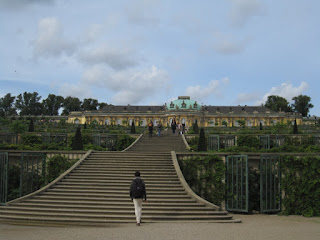
I spent my days in Berlin at a small, friendly hostel in super-hip Kreuzberg, by the river-- next to but not inside Toni's apartment, because of roommate visitor restrictions. Toni works as a tour guide for tourists from Spain and other Spanish-speaking countries, leading them around museums and sites in the city and its surroundings, so one day I borrowed his pass for the amazing Egypt museum on so-called "Museum Island" in central Berlin and surreptitiously watched him lead a tour. Another day, we went with his mother (who was also visiting) to Potsdam, a small town on the outskirts of Berlin. Potsdam is famous for San Souci, a very French palace built by a very German king that famously boasted a No Girls Allowed rule.
The first night I walked out to see the sunset

Wandering in these places with a trained tour guide was ideal. I learned a huge amount about Egyptian art, even taking into account my longtime fascination with the Egyptian mummies at the Museum of Fine Arts in Boston. And Toni was a great guide throughout Potsdam (which, apart from the beautiful palace, is both a charming small German town and the place where the remaining powers met after WWII to discuss the fate of Germany.)
In the evenings we cooked dinner, took walks, and found various atmospheric bars to catch up in over beers. One particularly memorable evening, we went dancing at a basement gay club with 1970s commercials projected on the chipped brick walls and a fun mix of "gay classics" (Cher, Rocky Horror) and locale-appropriate dance tunes (ABBA, 99 Luftballoons) on tap. I was able, for a period, to focus on just being there, instead of thinking of what I was heading toward or what I had left behind. It was a wonderful gift that Berlin and Toni gave me-- but ideas of departure and arrival were still stewing.
Toni walks the stairs at San Souci
Hieroglyphics at the Egyptian Museum

Despite our efforts at togetherness, Toni has an unbelievably frenetic schedule, so I spent a lot of the visit on my own. I wandered the city trying to regain my traveler's balance and rediscover what it was about the place I had loved so dearly when I came the first time. And I found it, at least in part. The city is blanketed by a gritty but creative un-"dressed up" atmosphere, which permeates everything. Many neighborhoods are still emerging from the dark ages of Communist rule, and the leftover blocky architecture and general used-to-be-decrepit feel speaks to that. But what is really magical about Berlin is what's done with that grittiness. A lesser city would just be content to be dirty, unsafe, and uninspiring, but Berliners have made it a mecca for creativity, art, and community. There are art galleries and concerts everywhere, and that's just on the officially established side. Street art decorates many buildings, concerts spring from nowhere, sculpture sprouts from the sidewalk.
On Sunday I went with a couchsurfer to the Mauer Park fleamarket, which I so adored my first time in Berlin. The park is in a former No Man's Land from the days of the Wall ("mauer" means "wall" in German), and on Sundays it is filled with rows upon rows of homemade or used clothing, furniture, funky crafts, jewelry, and food. We spent four hours in the drizzle trying on stuffed animal hats, exclaiming over zipper earrings, and wishing for enough money or luggage space to buy everything in sight. In the end, I binged on 7 pairs of amazingly funky 3 euro earrings. I was so glad to see something I remembered so lovingly live up to my memories.
Street art in Kreuzberg

It was a relief in particular because of another Berlin institution that I had heard was in danger: Tacheles, a 19th-century shopping mall left to rot in East Berlin under Communist rule, then saved by an artist collective and turned into studios, a sculpture park, a cafe, and more. I wrote about it here in 2009--then, as well, I was incredibly struck by the way these artists had turned something so ugly into so much beauty. I even bought a ring there that I wore every day as a reminder of my traveling accomplishments and personal growth--at least, until it disappeared last year. Now, rumors were flying: I had heard that Tacheles had been reclaimed by the bank when its current owner went into bankruptcy, that the whole thing had been knocked down, that the artists had left, or that it was being turned into condos. So I went back with trepidation, especially after having such a positive experience at Mauer Park.
But I felt I had to go: I had drawn so much inspiration and strength from the memory of Tacheles in the years after my trip, and I was much in need of some of that just now. Berlin wasn't just a quick pit stop for me, psychologically. It was a buffer period between my Old Life and the Life to Come. These days were easing me in to a very big change. I was marinating in transition and still very much not ready to let go of the happinesses of 2010 and early 2011.
Luckily, I arrived at Tacheles and breathed relief. Yes, the bank (or somebody) had kicked a lot of the artists out of the building itself, dismantled the old cafe, and attempted to bar entry by building a wall on which someone had spray painted "diese mauer ist eine schande fur berlin" or "This wall is a shame for Berlin." But, I discovered something magic in the back lot behind Tacheles: the same sculpture park thrived, and an improvised cafe housed people drinking beer on packing crates. The spirit of Tacheles was alive and well.
Part of the sculpture garden

I was buying a copper ring to replace my old one from an Italian jeweler when a painter beckoned to me from the opposite corner. In the course of our conversation he described an uncertain future--rumors abound that the bank will auction off the building in the spring. The painter guided me into a small trailer filled with his work and tried to convince me to buy a piece, but I had neither the money nor the suitcase space. Full of guilt and a love of the place, I gave him a couple of Euros.
His face split into a grin. "Thank you, thank you. Every little bit helps. So, would you like to ask for something from my statue?" he said. Doubtful, I followed him outside, where he pointed at a sculpture wielding a sword and a torch--a woman, powerful and intent.
"That's Shiva," he told me. "She's the destroyer and the creator, with her sword and torch. She is the ending and the beginning at once. They're the same, you see."
Then I was glad I had given him the Euro; the next day I was on my way to Spain.
Shiva

Tuesday, September 27, 2011
Breaking up with Boston, or It's Not You It's Me
I've decided that this move away from Boston is a bit like a tortured break up. Not the happy, fulfilled kind where both parties come away from the relationship knowing they were good for one another and ready to move on. Not even the kind where both parties end the relationship full of resentment and anger. No, it's what I suspect may be the worst kind: where both parties understand that they still love each other but that their dreams are leading them away from each other for now.
I wrote here recently about trusting in your dreams to direct you, even if those dreams have gone "stale" (as a friend of mine here put it recently). In that line, I've been imagining Boston and I as a couple of would-be doctors or lawyers who always wanted to go law school or to medical school but happened, inconveniently, to fall wildly in love. Boston and I carried briefcases around when we were 3 or tried to take our parents' temperature when we were 7. Boston spent weekends studying case law for mock trial in high school, while I took a college-level epidemiology course instead of joining swim team or the drama club.
In the days before my departure we were so in love that I was compelled to ask myself: well, wouldn't being a registered nurse or PA be just as nice? I could stay here with Boston and still work with patients. Boston could go to law school and I could join a private practice, giving flu shots and writing prescriptions... But really, if I was willing to give all that up, why couldn't Boston just go into social work while I went to medical school and achieved my dream? Boston and I had a lot of impassioned fights about this.
In the end, though, no one compromised. In a turn of events perhaps surprising to no one, Boston stayed steadfast on the east coast. It was I who got on the plane. Boston and I said our tearful goodbyes. We promised to keep in touch, but we knew things would never be the same. And I don't know if I can speak for Boston, but I for one wondered if I would ever love that way again.
I wrote here recently about trusting in your dreams to direct you, even if those dreams have gone "stale" (as a friend of mine here put it recently). In that line, I've been imagining Boston and I as a couple of would-be doctors or lawyers who always wanted to go law school or to medical school but happened, inconveniently, to fall wildly in love. Boston and I carried briefcases around when we were 3 or tried to take our parents' temperature when we were 7. Boston spent weekends studying case law for mock trial in high school, while I took a college-level epidemiology course instead of joining swim team or the drama club.
In the days before my departure we were so in love that I was compelled to ask myself: well, wouldn't being a registered nurse or PA be just as nice? I could stay here with Boston and still work with patients. Boston could go to law school and I could join a private practice, giving flu shots and writing prescriptions... But really, if I was willing to give all that up, why couldn't Boston just go into social work while I went to medical school and achieved my dream? Boston and I had a lot of impassioned fights about this.
In the end, though, no one compromised. In a turn of events perhaps surprising to no one, Boston stayed steadfast on the east coast. It was I who got on the plane. Boston and I said our tearful goodbyes. We promised to keep in touch, but we knew things would never be the same. And I don't know if I can speak for Boston, but I for one wondered if I would ever love that way again.
Friday, September 23, 2011
In-flight Entertainment
Airports in the middle of the night are strange. You stumble off this rumbling machine into a pile of glass and metal that looks an awful lot like the pile of glass and metal you left. Your mouth is dry and tastes off. You feel hazy, half in a dream, unsure of where you are. You're in a new place, but it doesn't feel like a new place. It doesn't feel like the old place either. It's an odd in-between.
It's especially strange if the airport is in Iceland at the end of the summer. It's 5:30 in the morning and bright like it's 10. You're surrounded by people whose chatter sounds like singing. Everything smells like herring. So you take your bag and wander through the halls to a bathroom, then make your way to a service desk to ask about changing from window to aisle.
A slight man with close-shaved head stands in front of you speaking with a familiar accent. He doesn't have a boarding pass and needs one to get to London for work. The clerk steps away from the desk for a moment and he asks you if you're going to London. No, you say: Berlin, then Spain.
He smiles. As his accent suggested, he is from Zaragoza. You brace for the obvious question and the pitying answer. Oh, Palencia? But why? I'm sorry. It will be interesting for you, but it's such a small city.
You are mentally putting on your "no, this year will be wonderful" armor. He asks the usual clarifying question. "Palencia! With a P? Not Valencia?"
No. Not Valencia. Except:
He breaks into a grin. His face lights up. "Now that is the real Spain! Palencia is beautiful! I mean, really. Have you ever wanted to live across from a Romanesque Cathedral? Now you can! Just make sure it's the kind that stops chiming between 12 am and 8 am... they usually do these days."
He takes a breath. "Oh, you're from Boston? I guess you're used to living near the sea. Well, this is different, but you still have the river. Very beautiful! Anyway, Zaragoza is inland, too. You'll see -- the people! They're so nice, so friendly. Maybe not as open as those in the south, but they are loyal, kind, and respectful. Good friends. My mother grew up in Soria, and I can tell you: inland people were wheat farmers for a long time. They are used to hard work, and they respect education."
The clerk returns. You listen to them discuss the boarding pass for a moment, then turn to leave. From the receding desk you hear him introduce himself.
"Good luck in Palencia! I am Jose Major Domo! E-mail me if you need anything." He gives his e-mail address.
A few minutes later, you board another plane, one step closer. A little bit less in a haze; a little bit more at ease. On the flight, the Icelandic women are wide awake, chattering, buying duty-free items, joking with the flight attendant. It's like a giant, strange party in the sky. It's like it's already mid-morning, instead of 3 am by your biological clock. It's like they don't know what you're heading toward.
It's especially strange if the airport is in Iceland at the end of the summer. It's 5:30 in the morning and bright like it's 10. You're surrounded by people whose chatter sounds like singing. Everything smells like herring. So you take your bag and wander through the halls to a bathroom, then make your way to a service desk to ask about changing from window to aisle.
A slight man with close-shaved head stands in front of you speaking with a familiar accent. He doesn't have a boarding pass and needs one to get to London for work. The clerk steps away from the desk for a moment and he asks you if you're going to London. No, you say: Berlin, then Spain.
He smiles. As his accent suggested, he is from Zaragoza. You brace for the obvious question and the pitying answer. Oh, Palencia? But why? I'm sorry. It will be interesting for you, but it's such a small city.
You are mentally putting on your "no, this year will be wonderful" armor. He asks the usual clarifying question. "Palencia! With a P? Not Valencia?"
No. Not Valencia. Except:
He breaks into a grin. His face lights up. "Now that is the real Spain! Palencia is beautiful! I mean, really. Have you ever wanted to live across from a Romanesque Cathedral? Now you can! Just make sure it's the kind that stops chiming between 12 am and 8 am... they usually do these days."
He takes a breath. "Oh, you're from Boston? I guess you're used to living near the sea. Well, this is different, but you still have the river. Very beautiful! Anyway, Zaragoza is inland, too. You'll see -- the people! They're so nice, so friendly. Maybe not as open as those in the south, but they are loyal, kind, and respectful. Good friends. My mother grew up in Soria, and I can tell you: inland people were wheat farmers for a long time. They are used to hard work, and they respect education."
The clerk returns. You listen to them discuss the boarding pass for a moment, then turn to leave. From the receding desk you hear him introduce himself.
"Good luck in Palencia! I am Jose Major Domo! E-mail me if you need anything." He gives his e-mail address.
A few minutes later, you board another plane, one step closer. A little bit less in a haze; a little bit more at ease. On the flight, the Icelandic women are wide awake, chattering, buying duty-free items, joking with the flight attendant. It's like a giant, strange party in the sky. It's like it's already mid-morning, instead of 3 am by your biological clock. It's like they don't know what you're heading toward.
Monday, September 12, 2011
Lucky/Stupid
Well, hello there. Fancy meeting you here.
It's been awhile, and the time stamp on the last entry here is solid proof. I stuck in one place for quite a bit-- following my stint in Mexico I got a job at a small, cozy private ESL school and settled into an exceedingly lovely life for the next 16 months. I really hit this one out of the park, I must say: a fascinating gig as a reporter for the Chinese/English bilingual newspaper the Sampan; an incredibly fulfilling internship at NPR affiliate WBUR; a fun-filled routine packed with pub trivia, folk dancing, karaoke, and lectures; a fantastically-located apartment stocked with goofy roommates; and a group of friends who often felt more like family. It may have been "only" a few months, but I put down roots during that time. Or maybe I should say roots upon roots-- I bonded in an adult way with a city that I've known and loved (and that has known me) since childhood. I have been excited, stimulated, fulfilled, loved. Many everyday bumps (and a few not-so-everyday ones) aside, it has been one of the best periods of my life.
Which leads me to the next thought: why in the world would I leave!?
For leave I have: on Thursday, September 15 at 3:30 PM I boarded a plane that took me in a rather circuitous route to Berlin, Germany. Following a four-day layover, another plane took me to Madrid, after which a bus ferried me to Palencia (pop. 75, 000), the small Castilla y Leon city in Spain that will be home for the next 10 months.
In the run up to my departure I crammed as much wonder into my days as I could. I organized bowling trips and group dinners; took river cruises to cement the layout of my beloved city in my mind’s eye; and overloaded myself with Asian cuisine and diner fare, two varieties I did not expect to be offered regularly in my new home. And every night after tiring myself out dancing, listening to live music, or spending blissful time with friends, I would wonder to myself: what am I doing, leaving? Am I making a terrible mistake?
One thing I’ve realized as I’ve adjusted to the beginnings of adulthood is that the singular dream is a myth. Sure, some of us have one thing we wish for that hangs on tenaciously as we mature, but dreams transform as we do, molded to fit the new selves we’re growing into. I always dreamed of being a writer, but that dream has been refined and altered from author and illustrator to travel writer to journalist, and back. And in just the same way, when I returned home from my trip around the world, I had a new dream to join the old ones. I had adored my nomadic existence, but I wanted to know a foreign life from the other side. I wanted a home away, cozy bakeries that I frequented for bread, a coffee shop whose barmen knew my name, a Sunday morning market routine. The pull of understanding life so thoroughly in another place was remarkably strong.
And so I applied to the Spanish Language Assistant program, run by the Spanish Ministry of Education, which brings Canadian and American citizens to Spain to help teach English in public schools. I wrote and re-wrote an essay, put all my documents together, got a recommendation from my boss, sent everything into the embassy, and waited.
But of course part of the point here is that life doesn't stand still, and by the time I was accepted to the program in March my dreams had changed. I was deeply ensconced in my new life, busy drinking cheap beer in little bars in my neighborhood, trying new foods in the countless ethnic restaurants surrounding my apartment, writing a series of articles on Chinese life in Boston's Charlestown neighborhood, and pitching stories about Sudanese politics or dolphin communication at my radio internship. As far as I was concerned, I was living my dream. Spain seemed very far away, in all senses of the phrase.
But, I thought, what do I know about what comes next? I feared that this supremely fulfilling life might be just a brief phase, a period of pretend that would be followed by the confusion, general unsteadiness, and angst most of my friends were experiencing. And hadn’t I always wanted to learn Spanish, to live in Europe? Hadn’t my 2009 self dreamed of siestas, salsa, and sweet, hot espresso in tiny silver cups? I accepted the position, although with trepidation.
The summer wore on, bringing with it details of the year to come (and increased anxieties which may well be discussed later in this blog.) I finally found rhythm and confidence at my internship, I spent more and more time with a close-knit circle of friends, I joined a Zumba class and went dancing, I attended barbecues and went on dates. And I thought: what’s better than this? What person in his or her right mind would voluntarily give this up?
In the weeks before my departure a lot of people I love and respect took time to tell me how brave they thought I was being to leave and try all this newness. They told me that they admired me greatly; some even admitted to feeling jealous. I thanked them and felt the warmth of mutual affection spread through my chest, but some part of me was also thinking: “Am I being brave, or am I being stupid?” And also: “I don’t want to be brave. I want to stay here.”
I wish I could tell you the exact moment when I realized I was half-blind, but I think it was more of a gradual realization. Nevertheless, here it is: really, for me “lucky” and “stupid” are two sides of the same coin. I’m lucky to have enjoyed that life which, for a few short months, was so perfect for who I was and what I needed. And I’m incredibly lucky to have a chance to leave that life and try out a dream I once had, even if it’s not the dream that most recently spoke to me the strongest--many people who cherish this dream will never realize it, and it's easy to forget that. But even with those opportunities, I think perhaps you need to be stupid about risk taking and going out of your comfort zone in order to accept the lucky circumstances offered to you.
Ultimately, I don’t deny the fear that comes with “stupid”—fear that things will never be the same (they won’t); fear that I might lose people I love (I might.) But I can also see the incredible luck I have in tasting this life for a year. I can make room for both sides of the coin at once; I can stand it on its edge. With that perspective comes a new question I have to ponder: if I follow a dream that once belonged to a person that was once me, what does that mean? Should you trust your dreams to know you better than you know yourself? I am either stupid enough or lucky enough to have a chance to find out. Maybe both.
Wednesday, April 7, 2010
Regresando
It's that time again-- I finished my six weeks in Mexico, and I'm en route back to the US. Boy do I have a lot of awesome stories to share with you guys. From the Equinoccio celebrations of Guachimontones to the Easter processions of San Miguel Allende to the creepy, fascinating mummies of Guanajuato. So stay tuned.
Subscribe to:
Posts (Atom)

