Showing posts with label Spain. Show all posts

Wednesday, May 21, 2014

Guest Post: Dodging Turnips for the "Spain Scoop"

Things have been so crazy around here that I forgot to tell everyone that I had a guest piece up a few weeks ago at the "Spain Scoop," which is one of my favorite English-language blogs here in Spain. (This is my second piece for them; long-time readers will remember that I wrote about a trip to Jaen last year, as well.) I'll post the beginning here; to see the rest, head over to their website!

True Manhood by Dodging Turnips--Move Over Viagra
Just when one thinks they have heard of every wild festival in Spain, another bizarre event is tossed to the forefront.  About two and one half hours, southwest of Madrid, is the mountain village of Piornal.  In snow laden streets, men are chased by turnip throwing demons.  Those who survive reasonably intact, are newly virile. Move over Viagra. Our guest expert, Alissa Greenberg, tells the truth on turnip tossing. - See more at: http://www.thespainscoop.com/festivals-spain-scoop/#sthash.NDzoB0fK.dpuf

True Manhood By Dodging Turnips – Move Over Viagra

- See more at: http://www.thespainscoop.com/festivals-spain-scoop/#sthash.NDzoB0fK.dpuf
By Alissa Greenberg

The morning of Jarramplas dawned clear and cold. It had snowed in the Sierra Gredos overnight, and a wintry paradise of delicately-frosted trees and families building snowmen greeted us as we approached Piornal, the highest village in Extremadura. Despite its population of just 1500, every year on January 19 and 20 Piornal hosts a festival that rivals the adrenaline of Pamplona's running of the bulls and the happy chaos of Tomatina in Valencia. We had come to investigate.

In the village, a festive atmosphere permeated, with every bar overflowing and swarms of teenagers in matching T-shirts running and shouting through the narrow alleyways. All along the main street, houses were covered in protective boards or netting. Turnips were piled in drifts along the sidewalk. Yes: turnips.

The short-version explanation is that each year five or six Piornalego men are tapped to act as “Jarramplas.” One by one, each dons an elaborate, multi-colored patchwork suit and horned helmet, then walks the streets of the village as the entire community pursues him, throwing turnips. (To prevent serious injuries, the suit and mask are reinforced with fiberglass.) The longer version is not that much longer: no one knows exactly where the tradition comes from, although prevailing wisdom suggests it started centuries ago when a cattle thief plaguing the village was punished with a bombardment of vegetables. These days, playing Jarramplas is considered a great honor and test of manhood. A waiting list stretches until 2030. 

We arrived in Piornal's main square just before 4 PM; people were streaming into the small, snowy plaza from all directions. The church bells began to sound, and there was a shout--“He’s coming! He’s coming!” A drumbeat sounded in the distance, and then: complete chaos.

To read more, click over to the Spain Scoop

Just when one thinks they have heard of every wild festival in Spain, another bizarre event is tossed to the forefront.  About two and one half hours, southwest of Madrid, is the mountain village of Piornal.  In snow laden streets, men are chased by turnip throwing demons.  Those who survive reasonably intact, are newly virile. Move over Viagra. Our guest expert, Alissa Greenberg, tells the truth on turnip tossing. - See more at: http://www.thespainscoop.com/festivals-spain-scoop/#sthash.NDzoB0fK.dpuf

True Manhood By Dodging Turnips – Move Over Viagra

IMG-20140119-WA0006
Just when one thinks they have heard of every wild festival in Spain, another bizarre event is tossed to the forefront.  About two and one half hours, southwest of Madrid, is the mountain village of Piornal.  In snow laden streets, men are chased by turnip throwing demons.  Those who survive reasonably intact, are newly virile. Move over Viagra. Our guest expert, Alissa Greenberg, tells the truth on turnip tossing.
By Alissa Greenberg
The morning of Jarramplas dawned clear and cold. It had snowed in the Sierra Gredos overnight, and a wintry paradise of delicately-frosted trees and families building snowmen greeted us as we approached Piornal, the highest village in Extremadura.
Despite its population of just 1,500, every year on January 19 and 20, Piornal hosts a festival that rivals the adrenaline of Pamplona’s running of the bulls and the happy chaos of Tomatina in Valencia. We had come to investigate.
- See more at: http://www.thespainscoop.com/festivals-spain-scoop/#sthash.NDzoB0fK.dpuf

Thursday, March 27, 2014

Vuelva Usted Mañana, Or: Adventures in the System


 *
Monsieur Sans-Delai made a proposal to install improvements in a certain government department which I shall not name, since it is highly regarded. In four days we returned to learn whether our plan had been approved. “Come back tomorrow,” the doorman said. “The Chief Clerk did not come in today.”
“Something very important must have detained him,” I said to myself.
We went out for a walk in Retiro Park, and we met – what a coincidence! – the Chief Clerk, very busy taking a stroll with his wife beneath the bright sun of Madrid’s clear winter skies.
The next day was Tuesday, and the doorman said to us: “Come back tomorrow, because the Honorable Chief Clerk isn’t seeing anyone today.”
“Some very important business must have come up,” I said.
And since I’m an impish devil, I sought an opportunity to look through the keyhole. His Honor was tossing a cigar butt into the fire, and had in his hand a puzzle from the Daily Mail which he must have been having some difficulty in solving. “It is impossible to see him today,” I said to my companion. “His Honor is indeed very busy.”
 *

That passage is from"Vuelva Usted Mañana" -- in English "Come Back Tomorrow, Sir." Written by Mariano Jose de Larra in 1833, it is a Kafka-esque satire of the unique culture of bureaucracy that mired Spain at the time, depicting the narrator's attempts to help a foreigner (the cleverly named Monsieur Sans-Delai) navigate the complexities of Spanish working culture.

Despite the exaggerated nature of satire, the personal demons de Larra was battling (he committed suicide three years later at the age of 28), and the passage of time, there is still quite the kernel of truth to be found in "Vuelva Usted Mañana" almost 200 years later. In general, my experience with bureaucracy in Spain has been just as thorny, surreal, and infuriating as that which de Larra describes, like the worst DMV--for non-Americans, Department of Motor Vehicles--you can imagine. (I should pause here to say that I have heard similarly nightmarish scenarios about foreign people living in the US. I know our government can be just as bad.) Here, the worst offender is definitely the Extranjeria, or Foreigners' Office.

Foreign non-EU nationals living in Spain need a residency card called a NIE, and the process to obtain one is hilariously complex. After filling out all the correct forms in triplicate and obtaining the right-sized photos (white background, no hats, no smiling) and documents, one must pay tasas, government fees that, for reasons that I'd guess are connected to anti-corruption, can only be paid at certain banks and not at the office itself. One goes to the bank, pays the clerk in cash, and receives a receipt that one then returns to the office as proof of payment. Sounds simple, right?

Well, first of all, when I renewed my NIE this year in Toledo the process had been designed so that you needed to pay two tasas, presumably to different entities. So far okay, just pay them both at the same time at the bank next door, easy peasy.

Except that the bank next store was open for exactly an hour each day for people without accounts who wanted to pay tasas; except the NIE process was such that one needed to pay the first tasa and come back to the office to get the documents needed for the second... then rinse, lather, repeat; the whole process had to start again, for no reason I can imagine.

I waited my turn in that taupe-walled purgatory full of crying babies and sullen faces, then gave my documents to a woman who hardly made eye contact as she read through them and asked questions so clipped she seemed to be swallowing the last three words. She gave me the first tasa and instructed me to come straight back to see her when I had finished.

The line was out the door when I paid the first fee, but I was lucky enough to make it in during the allotted hour next door. By the time I got back to the office, it was 1:00. I was starting to worry: the office would close in under and hour, and if I did not complete my paperwork it would mean disaster, as I was leaving to return to the US for the summer in five days. This would be my only chance.

The door was frosted glass, but I did the equivalent of the narrator in de Larra's story peeking through the keyhole: I peered in through clear, non-frosted edge of the door and saw that the desk was empty. 
"Do you know when the woman in that office will be back?" I asked the security guard.
"She went out," he said.
"Out? Out where?" I asked
"Sometimes she goes out. To smoke, or you know. She's just out."
"When will she be back? She told me to come see her, and I know the office is going to close soon."
He shrugged and turned to the next person in line.

I waited 20 minutes, cursing the empty chair. Finally, the woman appeared again. I got the second tasa, then sprinted around the neighborhood trying to find a bank that hadn't already closed (many banks close at 1:30 PM for lunch) and that would accept my non-account-holder money. The first two were closed, the third was members-only. At the fourth I hit pay dirt, paid my tasa, and sprinted back with 10 minutes to spare. 

"Sometimes I think they make the process so complicated to weed out people who can't handle it," another would-be immigrant said to me as we waited to drop off our paperwork.


 *
“Permit me, Monsieur Sans-Delai,” I said to him half in jest and half in earnest, “permit me to invite you to dine with me on the day you have spent fifteen months in Madrid.”
“What do you mean?”
“You will still be here in Madrid fifteen months from now.”
“Are you joking?”
“Certainly not!”
“I shall not be able to leave here when I please? The idea strikes me as very funny indeed!”
“You should realize that you are not in your bustling, businesslike country.”
“Ah, you Spaniards who have traveled abroad have acquired the habit of speaking ill of your country so that you can feel superior to your compatriots.”
“I assure you that during the two weeks you are planning to devote to these matters, you will not even be able to speak to a single one of the people whose cooperation you need.”
“What exaggeration! My energy will rub off on all of them.”
“Their inertia will rub off on you!”
 *

The narrator's blase attitude to the lack of "bustling, businesslike" behavior is entirely true to life. Much like Americans are resigned to the unpleasantness of the DMV, most Spaniards I've met have been annoyed by but resigned to the pace at which things get done in this country and the attitude many people take towards work schedules-- the same attitude that allowed the woman at the Foreign Office to take unscheduled breaks without telling anyone where she was going or when she would be back.

Take my roommate, Judith: at the beginning of this year, she needed to send some important documents via a private firm similar to Mailboxes Etc. I was present during at least a half a dozen attempts Judith made to catch the proprietor of the store while she was working, all during what were supposedly business hours. Each time we would arrive at the store to find the door locked but the lights on, the "open" sign mocking us. A couple days Judith even called beforehand to make sure the store was open. She was assured that someone would be there to attend her, but by but by the time we arrived the worker had stepped out. Where? It was anyone's guess. Judith was annoyed, of course, by all this-- as any human would be. But she was not surprised.  It's just how things work here, she said.

I even found myself repeating the same mantra during the aforementioned adventures within the public healthcare system. As the schedules changed with no warning, required document lists seemed to alter overnight, and I was told over and over "come back tomorrow with [x] and see [y], instead," I felt first frustration, then a heavy resignation. "It's just how things are" is a dangerous attitude in some ways, but it can be a comfort.


 *
Very early the next day we went out together to look for a genealogist, which could be done only by asking one friend or acquaintance after another. Finally we found one, and the good man, stunned by our haste, declared frankly that he needed some time for this; we pressed him, and he finally told us as a great favor that we should come around in a few days. I smiled, and we left. Three days passed, and we returned. “Come back tomorrow,” the maid told us. “The master is not up yet.”
“Come back tomorrow,” she told us the next day. “The master has just gone out.”
“Come back tomorrow,” she said on the following day. “The master is taking his siesta.
“Come back tomorrow,” she answered the next Monday. “Today he has gone to the bullfight.” At what time can one see a Spaniard?
Finally we saw him.
“Come back tomorrow,” he told us, “because I have forgotten the document.”
“Come back tomorrow, because the final copy needs touching up.”
  *

After all that trouble, I was supposed to wait for a document in the mail assigning me a date for a second appointment at the Foreigners' Office. Since I didn't have an apartment in Talavera yet, I put down the address of my school. However, throughout the summer, the document did not arrive to the school. It didn't arrive in September or October, either. This was a problem because not completing the process and receiving my residency card meant no health insurance  (the application for which was a separate long, boring adventure in Spanish bureaucracy in itself) and no ability to travel abroad. I called the office in Toledo every day for 10 days, and it either rang indefinitely or was busy for hours on end.

I could have ended up like Monsieur Sans-Delai, stuck in an endless parade of "tomorrow-itis", waiting for a resolution that would never come. I thought perhaps I would never get my card at all. Perhaps I would be stuck forever fruitlessly fighting the women working in the Health Center to assure them that I deserved insurance despite my difficulties. Maybe I would simply never be able to use my credit cards or travel outside Spain this year. I was even convincing myself that maybe that might be okay. Who needs a doctor or to spend Christmas with loved ones? 

Luckily, I discovered that there is one cure for "mañana-itis" Perhaps you'll have guessed it; I certainly should have. The key is Knowing Someone.

I had reached my wits end, getting busy signals and non-answers and "call back tomorrows" until... it came to light that the parent of one of the students at school knew someone in the Talavera branch of the Foreigner's Office. One day I was trying desperately to get anyone to answer the phone in Toledo; the next day I had all my documents stamped and was missing only the physical card, which would arrive the next week.

That day went by in a blur. At 9 am I arrived at school; I was informed at 9:30 that they had managed to get me an appointment in Toledo the next week, despite the missing document; at 10 that I needed to provide my passport information to the school administrator immediately; and at 10:30 that we would leave at 11:15 to meet the friend-of-the-student's-parent during her coffee break at the Talavera foreign office. At breakneck speed, the principal of the school whisked me around town to pick up my passport, take the requisite passport photos at a novelty photo machine, pay the tasa (only one this time), and then... somehow by 12:30 I was sitting in the Foreigners' Office, all problems resolved, never having had to return to Toledo, uncertain what was happening, but assured I could come and pick up my new card before traveling abroad to Luxembourg the next week.

A deep breath and a mental shrug are the only viable reactions to such things. With that level of confusion comes a kind of zen peace. Accepting the sheer opacity of Spanish bureaucracy means understanding that these things are out of your control, and sometimes you just need to let yourself get swept along in the tide and hope someone who knows better is working in your favor.


 *
I shall confess to you that I do nothing today that can be put off until tomorrow; I shall tell you that I get up at eleven in the morning, and take a siesta in the afternoon; and that I spend seven and eight hours at a stretch loafing at a table in a cafe, talking – or snoring – like a good Spaniard. I shall add that when the cafe is closed I drag myself slowly to my daily appointment (because out of laziness I make only one), and that I can be found glued to a chair smoking one cigarette after another and yawning continually until twelve or one o’clock in the morning; that many evenings I do not dine because I am too lazy, and that I am even too lazy to go to bed!
 *

In the last paragraphs of de Larra's story, he offers this list of some of the nicer aspects of Spanish life. Perhaps it's not how he meant them, but for me the passage serves as a reminder that it's not all bad here; in fact, far from it. It highlights for me some of the lovelier luxuries of the Spanish lifestyle and the motives and values that help make them reality. The pleasure of a siesta after school, a two-hour coffee outside under the trees in a cafe terrace, a long lunch on Sunday with friends, a leisurely walk down the Calle Mayor, a late-night beer in a tapas bar-- they all come from that same impulse to relax, to keep a less-hurried pace. If the price of all that is "Vuelva usted mañana," well... I suppose it's a price I'm willing to pay.


*
*

*The passages in this piece are excerpted from the website  www.spanishliteratureintranslation.com. To read the full story, click here

Monday, March 24, 2014

Deep thoughts at the frutería


One of my favorite things about living in Europe is the commonness of butchers, greengrocers (known in Spain as fruterías), and small markets. I always prefer to spend my money at small businesses, and living in Spain makes that easy. One of my favorite things about my apartment this year in Talavera is that I live in a plaza that includes a mom-and-pop butcher shop, a frutería with an extremely chatty owner, several South American bodega-style shops that sell a little bit of everything, and a supermarket for whatever is leftover.

Today, while stocking up on produce, I overheard the following conversation (which, I may say, would never happen in a supermarket.) I assure you that it sounded even more lyrical in Spanish.

Customer: How are the clementines today?
Greengrocer: Sweet like love
Customer 2: But how sweet is love, really?
Greengrocer: Love is the sweetest thing! It's us who add the salt.

And that, friends, is your deep thought for the day.

Monday, March 10, 2014

Photo Post: Open House at the Bullring

Let me preface these photos by saying that in my three years in Spain, I have attended one bullfight. I had deeply mixed feelings about it-- a combination of, on one hand, fascination and respect for centuries of tradition and an aesthetically beautiful sport and, on the other hand, disgust, discomfort, and sadness at the celebration of the death of a living thing. I have talked with interest to people on all sides of the issue and have found something to agree with in all of their perspectives.

But this post is not about bullfighting. 

You will not see any photos of bulls at all. The photos below were taken during an open house held at the bullring in Talavera de la Reina, outside of the bullfighting schedule (in any case, a second string ring like this one only hosts a few fights a year.) The guided tour I went on was an opportunity to peek behind the curtain to see parts of the ring that the audience at a bullfight cannot, and the images presented here seek to share this glimpse with you. They do not put forward any opinion except that every controversy is worth investigating and that things that make us uncomfortable can still provide beauty.


"La Caprichiosa" bullring, reinaugurated in 1890 after some years of disuse, as viewed from outside in the gardens of Nuestra Senora del Prado. The ancient basilica, whose roots date from the year 602, can be seen in the background.

*
Perhaps my favorite shot of the day. The open house included a workshop in "toreo de salon" or "bullfighting for the living room," which attracted a number of adorable wannabe bullfighters. I caught this little boy living out his dreams with a traditional bullfighters cape, undoubtedly with the roar of an absent crowd in his ears.
*

The empty bullring encouraged exploration. Here, just by the divider before the ring itself, is where officials and ringworkers (including the all-important veterinarians) sit
*

The empty arena, with the Basilica rising behind it

*

Toreo de Salon from above, this time adding a practice bull made from an augmented wheelbarrow. I'm told all bullfighters start training with the wheelbarrow. These boys had stars in their eyes, just practicing in the ring.
*

This fence separates the "shadow" and "sun" sections of the bullring, which represents a significant difference in ticket price. Such concerns are paramount on summer afternoons with temperatures reaching above 100 F/40 C

*

At this point, our tour left the public portion of the bullring. We went first into an area from which we could see into the paddocks where the bulls are kept the day before a fight. (League rules require that bulls arrive at least 24 hours before a fight.) Bullring workeres use a series of catwalks above the paddocks to be able to check on the bulls' wellbeing from above, without startling the bulls or risking their own safety.
Here: a view through a chestnut tree growing in the paddock, looking up at the Basilica.
*

A small detail: door number 4 in the "chiqueros," the stalls where the bulls are kept directly before a fight

*

A more complete view of the chiqueros. They are closely guarded to assure that no one tampers with the bulls before a fight. In the cutthroat world of bullfighting, it has happened before.

*

A view of the "toreo de salon" action through the small door by which the bullfighter historically enters to greet the crowd

*

The sign says "All outsiders are prohibited entrance." I was pleased to get a shot from behind the door.
 
*

A terrifying look behind the scenes: the infirmary, in case of Worst Case Scenarios. (There is also a chapel on sight for similar purposes.)

*

The caretaker lives permanently inside the bullring, making sure everything is okay 24/7. He has quite a view out his back window... out his front window, too, now that I think about it.

*

Another blooming torero practices

Tuesday, February 11, 2014

A Catalan Christmas in February (Part 2): Scatalogical Humor Edition

My Catalan family and me, posing Christmas 2010 with Caga Tio

The world-famous city of Barcelona is many things: cosmopolitan, rich in history and cuisine, full of pick-pockets, and completely fascinating, to name of a few. It's famous for its storied soccer team and nightlife and for the long-standing independence movement that would separate it and the larger region of Catalunya from the rest of Spain. But that is not what I am here to tell you about.

No, I am here to tell you poop jokes.

I've already taken pains to describe some of the things that make Spanish Christmas unique, but there are a few important -- and, in my opinion, quirkily hilarious-- Catalan traditions that I specifically left to discuss separately. Catalans (people who live in Barcelona and the state of Catalunya) speak a separate romance language; have many separate festivals and holidays; and, if you buy into the prevailing wisdom, are generally more serious and buttoned up than other Iberian people.

... or maybe not so buttoned up. There are two Catalan Christmas traditions that are unique when compared to any others I've heard of anywhere in the world. Celebrating two Christmases in a row (2009 and 2010) in Barcelona gave me a healthy appreciation of both. Warning: if you don't appreciate scatalogical humor, read no further. But if you want to know what poop and the manger in Bethlehem have in common, read on. First up:

1) The Caganer


Vulgar? Yes. Hilarious? Yes.

The first thing you need to know is that cagar in Spanish (and, one assumes, Catalan) means "to take a crap," or possibly something more vulgar than that, a word I'll try to use minimally on this, a family publication. Next, recall that the creche, or nativity scene, is an important part of Spanish Christmas, playing the part that Christmas trees do in the United States. Okay: now that you have been armed with that information, I can explain to you that the Caganer is an important and unique figure in the Catalan creche. Traditionally, he is dressed in traditional peasant clothes, wears a floppy hat, smokes a pipe... and is crouching down to take a bowel movement. Yes, right there in the manger, usually in the corner. Sometimes the porcelain even includes some tasteful tendrils of steam rising up from the fresh specimen.

No one knows exactly where this tradition comes from, only that it goes back hundreds of years (the first recorded Caganer dates from the 18th century.) Some historians say it's a fertility thing; most throw up their hands in confusion. What's for sure is that the Caganer remains as essential a part of the Catalan creche as the angels or the wise men. In fact, in recent years manufacturars of creche components have started to vary available Caganer options-- they make pooping wise men, pooping angels, pooping politicians and athletes. In googling around for images to post in this entry I saw Obama caganers, Angela Merkel caganers, Leo Messi caganers, and more. Basically, chances are that if there is a person in the public eye somewhere in the world, he or she has been immortalized in porcelain mid-poop and sits festively in a Catalan businessman's nativity scene on the Costa Brava.


2) Caga Tió

Mr. Poop, himself, ready for action
Time for a pop quiz. Do you still remember what cagar means, from part 1? If so, you probably can guess the direction we're headed here. To get the full effect, you also need to know that tió is old Catalan for "log." Put the two together and you get the Pooping Log (or something a bit more vulgar if you prefer), and it is exactly as absurd as it sounds.  Caga Tió is a jaunty Christmas visitor made out of a log (of varying size) painted with a face, wearing a red floppy hat, and smoking a pipe. He is the Santa Claus of Catalunya.

Now, say it's the first week in December-- time to decorate your Barcelona apartment! You put up some tinsel; arrange your creche, complete with pooping angel; and head to the Christmas market to find the perfect Pooping Log. The first step in selecting a proper Caga Tió is to decide on size, shape, and temperament. Is he smiling? Is he smoking? Is he tiny or enormous? Which one do you prefer?

Caga Tiós of all sizes at the Barcelona Christmas market
Now, you place the lucky log in a place of honor in the living room, and twelve days before Christmas, the fun starts. Every night little Catalan children leave snacks for Caga Tió, much as American kids leave cookies for Santa or carrots for his reindeer. The idea is to fatten Caga Tió up before Christmas Eve. In the morning the food is gone, having been dispatched by parental late-night munchies. Take care not to put on weight during this week-and-a-half of illicit snacking!

Finally, on Christmas Eve, all is prepared. As in other parts of Spain, multiple generations of your family gather together to eat a late, multi-course dinner, which usually includes sopa de galets (soup with pasta shells) and carn d'olla (stewed meet with vegetables.) Then, at midnight everyone sits down together in the living room. Trying not to let the children see, you cover the door with a blanket,  place all the presents under a chair behind the blanket, and put Caga Tió in front so all but Mr. Poop himself is hidden from view. (Another common set-up is a stack of gifts covered with a blanket and with Caga Tió as king of the mountain.)

Then the fun starts! The children of the family hit poor Caga Tió, all bloated with 12 days of food, with a stick (we used a wooden spoon) and sing a traditional song. I won't hide how hilarious I find the lyrics, especially in context as sung by angelic-faced children to a lovely tuneful melody.


Caga tió,
caga torró,
avellanes i mató,
si no cagues bé
et daré un cop de bastó.
caga tió!"
 Shit, log!
 shit nougat,
 hazelnuts and cheese.
 If you don't shit well,
 I'll hit you with a stick.
 Shit, log! 

"Caga tió,                        Shit, log,
tió de Nadal,                    log of Christmas!
no caguis arengades,       Don't shit herrings,
que són massa salades    which are too salty.
caga torrons                    Shit nougats,
que són més bons!           which are much better!

When the log can take no more, one of the adults waiting behind the curtain pushes the presents out from their hiding place behind the blanket, making it appear that Caga Tió is pooping presents.  (As one might guess from the lyrics, older traditions had Caga Tió bringing only torrons, or nougat, instead of today's gift haul.) The song is repeated until all the gifts have been opened. The rest of the evening is taken up sitting around the living room singing Christmas songs, drinking coffee or wine, and slowly drifting off to bed. Merry Christmas, indeed!

(If this reminds you of Mr. Hanky the Christmas Poo from "South Park," you aren't the only one. Although I've never ready anything definitive, it seems impossible that the beloved/hated character would have absolutely no connection here.)

*Due to a translation error, this post has been updated throughout

Merry Christmas in February from Wide Eyes Wider World!

Saturday, January 25, 2014

A Spanish Christmas in January (part 1)

Plaza San Francisco, Linares, all decked out
I've lived in Spain for almost three years, but my experience with Spanish Christmas goes back further than that. Long-time readers of this blog may remember that Spain was my last stop on my trip around the world in 2009, when I spent 10 days over Christmas with my dear friend Toni and his family in Barcelona. The next year I returned for a week in Andalucia (stopping in Sevilla, Malaga, and Cadiz) and a second round of Catalan Christmas with Toni. In 2011, when I moved to Spain, Spanish Christmas already felt like an old friend.

... which is why I was surprised to realize I have never written anything in depth about these traditions, especially when there are so many interesting ones. Since I am anticipating that this year will mark my last Christmas in Spain for awhile, now seems an excellent time to correct this egregious error:

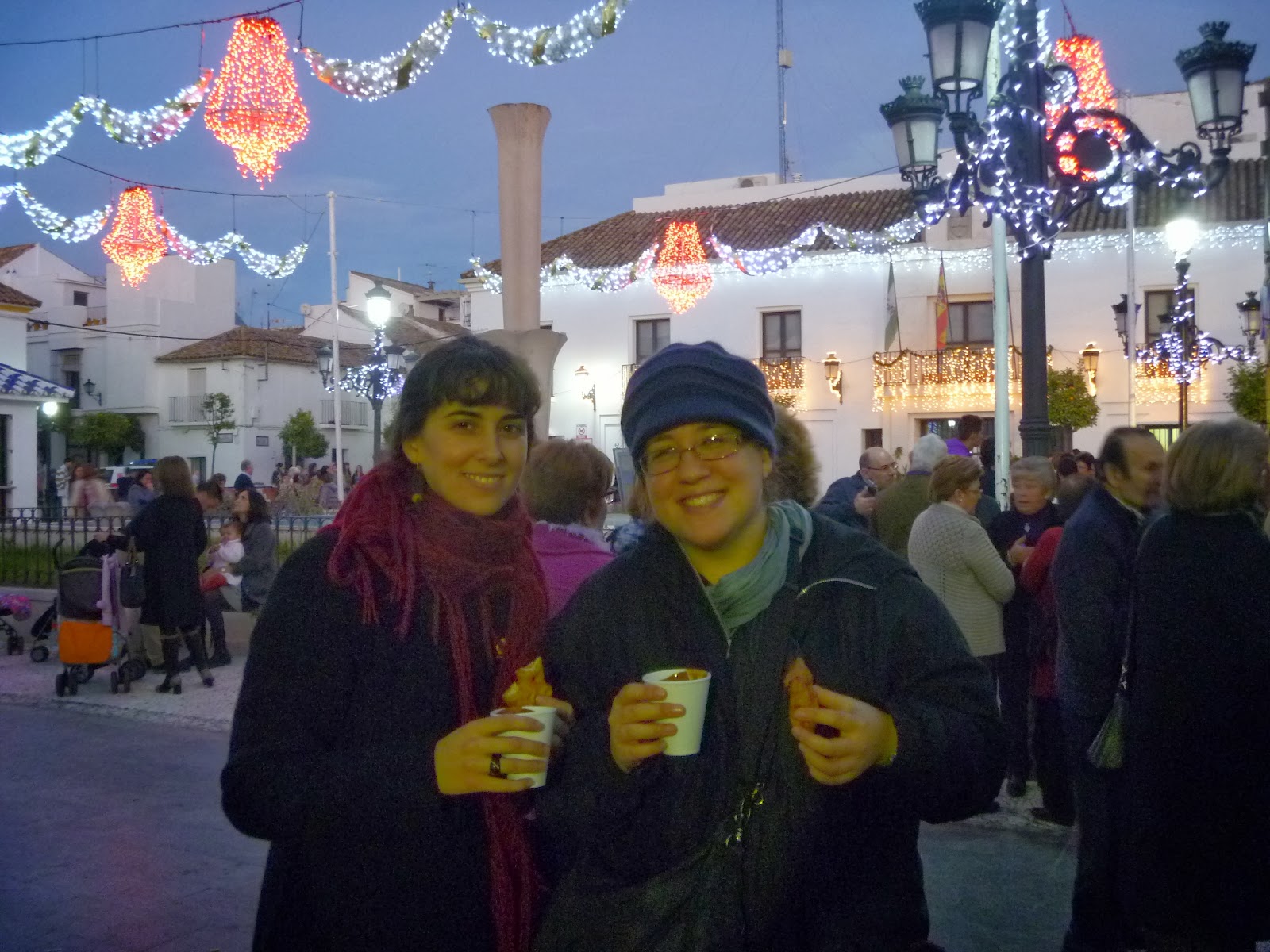
The Christmas season starts more or less officially in Spain during the first week of December, specifically at Candelaria on December 8. Around that time, Christmas lights and other decorations go up throughout the country, from the most elaborate in Madrid to the most simple in tiny Huelva villages. In my five Spanish Christmases, I have concluded that Christmas lights in Spain are of a very specific style. Unlike in the US, where strings of white or multicolored lights and tacky neon reindeer rule, Spanish lights are hung from cables that crisscross streets and boulevards, creating bold, blocky patterns or loop-de-loops that are very distinct from the American-style.


Typical Christmas lights hang on a street in Cadiz
The hanging of lights is often accompanied by installation of a Christmas market in the town square or one of the city plazas. Although Christmas trees are becoming more popular as American and British traditions trickle into Spain, most families still have a carefully-constructed nativity scene in their living rooms to mark the season-- in Andalucia in particular, these can grow to enormous sizes. People devote huge amounts of time and effort to constructing entire tiny Bethlehems, many of which include water features, electric lights, and timed sunrises and sunsets. In Linares, the government sponsored an enormous nativity scene that took up an entire empty store on the shopping street. Given the centrality of the nativity scene, the Christmas markets usually boast a section devoted entirely to selling tiny ceramic wise men, camels, or angels; they also offer decent amount of schlock and, if you're lucky, some respectable arts and crafts. Last year I bought a gorgeous handmade stool crafted from a whole olive-tree stump for 10 euros.

The nativity scene at my school in Talavera de la Reina
    
Traditional Christmastime food differs according to region, but one particular favorite of mine can be found throughout the country: mantecados and polvorónes. Stay with me for a moment here: much like the famous square-rectangle conundrum, polvorónes are mantecados, but not all mantecados are  polvorónes (the difference has to do with the specific recipe.) The nonetheless similar sweets are a sort of crumbly shortbread originally introduced by the Moors (ironic, yes?) Interesting fact: later on, the key ingredient was switched to pork fat, and the Inquisition forced detainees to eat the sweets in order to ferret out secret Muslims and Jews (manteca is pork lard in Spanish.) These days, mantecados and polvorónes are most popular in Andalucia but can be found almost literally everywhere during December. They are extremely delicious and terrible for you.

Christmas sweets. The paper-wrapped sweet on the lower right is a mantecado; the foil wrappers are polvorónes and the others are marzipan and candied fruit from Aragon, two other traditional Christmas treats
Christmas anticipation runs up to December 24, also known as nochebuena (the "good night"). Spanish families all over the country gather to eat Christmas dinner starting around 10:30 or 11 and finishing, in leisurely fashion, after midnight. Except in Catalonia (more on that in the next entry), no gifts are exchanged, but the meal is generally of many courses and includes extended family that has come from all over to eat together. After the last of the flan is finished off, everyone goes out for the night-- nochebuena is known as one of the most raucous "nights out" in the entire year. The bars are filled with people of all ages well into the next morning, when many people like to partake in chocolate con churros. This past year, when I spent Christmas in the white towns of Cadiz, we started our night out at 1 AM. I took a nap around 3:30 and my friend Maria woke me at 4:45, when we left to continue the party at a friend's country house. There, festivities (including Christmas carol singing, listening to Spanish metal, and drinking red wine with Coca-cola) continued until 8:30 AM. Needless to say, I didn't last that long.

The next morning, when the entire village/city has dragged itself out of bed to drink an espresso and attempt to recover... still Christmas is not over. In Spanish, people refer to "navidades" in plural, and my personal theory is that this is because it is refers more to a "Christmas season" than a single day. Besides Christmas Eve and Day the term also refers to New Year's Eve (nochevieja or "old night"-- no one has ever explained to me why it's called that)  and 3 Kings Day.  New Year's Eve is celebrated much the same as its Christmas counterpart, with a multi-course all-family meal that lasts until the wee hours. The major difference is a pause at midnight: as the clock strikes 12, families all over Spain endeavor to eat one grape in tandem with each strike of the cathedral clock-- a challenging task, as the grapes here generally have seeds. I'll let my roommate, Judith, explain to you what an impossible task that is: "Every year I try, and every year I end up like a hamster with my cheeks full of grapes, wishing everyone 'Happy New Year'-- and my parents say, 'Judith, don't talk with your mouth full,'" she explained to me cheerfully earlier this month, as we caught up on our Christmas vacations.


Christmas in the white villages of Cadiz; hot chocolate in the town square of Prado del Rey
  
And yet, even with the grape ordeal in the past, Navidades is not yet complete-- not until January 6 and the arrival of the Reyes Magos (the figures that Americans know as the three Wise Men but whose names are frequently translated here as the "Magic Kings.") Although Santa Claus has made an appearance in Spanish pop culture in recent years, he is not the beloved bringer of presents that he is elsewhere. Spanish children must wait until the morning of January 6 to see what the three Kings of biblical lore (you know, they followed the star to Bethlehem, or something? Don't ask me, I'm a Jew) brought them. The "Dia de Los Reyes Magos,"  full of presents and -- you guessed it-- another multi-generational multi-course meal, is preceded on the evening of January 5 by the "cabalgata de reyes magos," an elaborate procession-cum-parade through the streets announcing the arrival of the Kings. Virtually every community in the country, from the smallest town to the largest metropolis, hosts its own cabalgata, usually featuring Disney characters with oversized heads, some of whom arrive on horseback. The cabalgata in Madrid is largely agreed to be the most impressive, including a great many floats; public opinion generally has it that the quality of other cabalgatas has waned dramatically throughout the country with the onset of the economic crisis. Still, crisis or no, the cabalgata is a must for every under-15 child in town, seeing as every parade includes some frankly intense levels of candy throwing. I know of children who bring umbrellas to turn upside down in order to catch a maximum quantity of sweets. 

From there, I guess you can imagine the rest. Keyed up children, zooming around the house powered by candy overdose; comatose post-sugar crash kids heading sleepily to bed; those same tykes waking at an ungodly hour to see what the Kings have brought (this year they brought me my very own marker/crayon/colored pencil set, complete with pencil case-- there is so much coloring in my future!). And then, once the presents have been opened, the three-course lunch consumed, the last drop of coffee drunk... only then is navidades finished...

... until the next day, when rebajas (enormous city-wide after-Christmas sales) begin, of course.

Christmas lights by the ancient wall in Talavera. I am unsure what special effect I accidentally engaged to make them twinkle like that, but I don't mind. I kind of like it.

Tuesday, December 3, 2013

Strange Fruit 2

I ended the last entry in this series with a note about a pet peeve-- the infuriating and ubiquitous Spanish bar napkin. So I'll start with another one for this second edition of "Weird Things Spanish People Do That You Probably Didn't Know About."

1) They leave dog poop in the middle of the sidewalk
Obviously, this is a problem in the US, too, and in other countries. But as someone who is hoping to hit 41 countries by the end of this year, I can say that I have never been anywhere where the dog poop situation is quite so bad. My theory is that this problem is due to a lack of green space or bushes (for disposal) and a culture of impunity. Spaniards leave poop everywhere. The river walk in Talavera along the Rio Tajo is like a damn obstacle course. I can't count the number of times during my stay in Spain that I was walking along looking at the scenery -- wrought iron balconies over windows in sugary colors, charming side streets under stone arches-- or even just looking at a map and ... SQUISH. Ugh. It's true that laws exist against such practices, but they are poorly enforced. Gross.

The famous balconies of Madrid. But don't get too distracted...

2)  They say completely meaningless things to fill the silence
While it's true this kind of phrase exists in every language,  the phrase "bueno, pues nada" (which translates directly to "Okay, well... nothing") is surprisingly ubiquitous. It usually pops up at the end of a conversation, when things have more or less finished up and neither party has anything left to say. Where an American would probably stay mum and look around awkwardly (and, let's be honest, pretend to text a friend), a Spanish person is more likely to pull out this bad boy. The phrase is a good indicator that the conversation is now finished; the equivalent of "So, uh... yeah." It is a placeholder. It literally serves no other use.

3) They narrate their actions
This is something specifically that I've noticed since my arrival in Talavera. Maribel, one of my co-teachers here, often will come into the staff room Morgan-Freeman style (that is, doing voice over for her life.) "I'm going to wash my hands," she'll announce to no one in particular. Then; "Well, I guess I'll go upstairs." Similarly, my roomate, Judith, would never dare going to sleep without announcing: "I'm going to bed! Goodnight!"

I'll admit it, my American reaction is: '...So? Why are you telling me? What do I care?' But when I asked Judith about this habit, she explained that it's about being polite. If Maribel merely walked into the staffroom without saying anything, it would be like not acknowledging my presence; similarly, if Judith went to bed without telling me it would be an indication of bad blood between us.

Spaniards: human news tickers


4) They mean something totally different than Americans/British people do when they say "Let's meet this morning" or "I'll talk to you this afternoon" 
You probably know that Spanish people eat on an entirely different schedule than Americans/Brits/most of the non-Mediterranean Western world. Lunch is between 2 and 3; dinner is between 9 and 10:30. What you probably didn't know, however is that the eating schedule affects the working definition of "morning" and "afternoon." One is permitted to say "Buenos dias" until 2 pm and "Buenas tardes" until 8 or 9. Thus, I offer you the following tip when making plans with a Spaniard: keep in mind that meeting "this afternoon" means that any time between 3:30 and 8 is up for grabs. This can be especially confusing when talking to a Spaniard in English. He or she may say "I am only free this morning," and although the language is English, the idea of morning is still Spanish-- leaving lots of potential for misunderstanding.

5) They eat bread with EVERYTHING
Seriously, everything. My favorite story to tell about this habit takes place in Santander, with a couchsurfing host.We were preparing lunch from some leftovers: tortilla de patatas (kind of a quiche with potatoes inside) and arroz a la cubana (rice with peas and meat), plus some pasta we made to finish the meal off. There, amongst this cornucopia of carbohydrates, my host exclaimed in horror, "Oh my God, I'm so sorry! I forgot the bread!" Needless to say, I did not mind.

The classic "tortilla" with potatoes ... and bread

Bonus:
From what I can tell, this only applies to Manchegos, people born in Castilla la Mancha, where I live this year. When asked a question they don't have an answer for, instead of saying "Yo no sé" (I don't know), they say: "Yo qué sé?"-- "What do I know?" I don't know what it is about that little difference that gets me, but I always enjoy walking around and overhearing people say "What do I know?" What, indeed, do any of us know? That's deep, Castilla la Mancha. That's deep.

Tuesday, October 22, 2013

Strange Fruit, 1

A barman at his station in Cadiz
After two and a half years living in a foreign country, the idea of what is "normal" has redefined itself many times over. The strange quirks that jumped out at me so dramatically when I first arrived now seem obvious. It's easy to forget that I ever didn't know that a long weekend is called a "puente"--or bridge-- because it often connects a legitimate holiday with the weekend, taking innocent days with it. And it comes as second nature that I have to think about what time I take out the trash because if a policeman saw me bring it out before 8 PM I could get fined. Although it takes some effort to return to that everything-is-new state of mind, I've been meaning to post some observations for awhile, so I'll do my best.

Thus, I present to you: 4 Strange Things Spaniards Do (That You Probably Didn't Know About.)  And if you enjoy these, I'll post four more next week, as well!

1) They say goodbye instead of hello
I've written about this before in a different form, so it makes a good place to start. One of the first things I noticed when I arrived in Palencia two years ago was my neighbors' insistence on saying "Buenos dias (good morning)/"Buenas tardes (good afternoon)" and "hasta luego" (see you later) during our brief interactions in the elevator. It struck me as very odd, since American elevator etiquette relieves the rider from interacting with his/her riding companions at all. Why, I thought, waste the energy to greet someone, only to have to say goodbye to them 15 seconds later? (Plus, I found the Spanish way of saying "Hasta luego", which seems to elide multiple syllables into the linguistic ether, endlessly mysterious.) I was told, however, that not acknowledging one's companions in elevator travel would be a serious insult. Greetings are of tantamount importance here.
The strangeness only grew over the years: during walks in the evening paseo, I heard neighbors greeting each other, and once in awhile instead of hello's I heard instead "Hasta luego!" It seemed very strange that a person would start an interaction with someone by saying "See you later!", but after my previous assumptions I kept this thought to myself-- until I started to hear it more and more after I arrived in Talavera. Finally, I brought the topic up with my roommate. She looked at me like I was crazy. "Why would you open up a conversation with someone if you had neither the time nor intention of talking with them?" she asked me. "This way, we're saying 'Yes, I've seen you, but I don't have time to stop. We'll talk later, another time.'" I admit that this is a much more sensible explanation than I was expecting.

2) They tell strangers 'bon appetit'
Spaniards eager to improve their English often ask me what Americans say to each other before they eat. I am forced then to explain the awkward fact that we don't have any special phrase-- that, in fact, we stole the French phrase 'bon appetit' for the purpose (and that, actually, we stole a lot from the French... and the Germans and the Greeks and so on). 
 This is often confusing to them because the phrase "buen provecho" is an important part of Spanish etiquette, and it's hard for them to imagine a language that doesn't have its own version. Here, one says "buen provecho" before eating with friends or coworkers (usually in more formal settings), the same way one might use "bon appetit" in the US. But the big difference is that some people also say it to anyone they see eating, even strangers. They see it as a breach of etiquette not to do so. 
How seriously do they take this etiquette, you ask? Let's take Saturday a few weeks ago as an example. Hannah came to visit me from Jaen, and I took her to the monthly medieval-style market that takes place along the ancient walls here. (Did I mention that Talavera has 800-year-old Moorish walls? Cool, right?) We bought hunks of empanada, pastry stuffed with meat and veggies, and took them down to the river to eat by the Roman bridge (which is actually a Moorish copy of an earlier Roman bridge. Double cool!), while watching the water birds fly by. As we were tucking in, a bicycle came whizzing down the path in front of us. We barely had time to register his blur zooming past us before he was gone, with merely the call of "Buen provecho!" to let us know we hadn't imagined him.
So: really seriously.


The "Roman" bridge, Talavera

3) They continually use napkins that don't actually work
 Spanish bars are a nationwide gem: of this there is no doubt. On any corner in any Spanish city or town you can find one: a little counter, tucked in a corner, shabby but clean; a polished espresso machine, buzzing and whirring; a beer or cider tap flowing at all hours of the morning and evening; and a small TV playing a talk show, bullfight, or soccer game in the corner. There's always an old guy in a great hat having a beer (even at 11 AM); there's usually a leg of ham, half decimated, by the cold tapas display. Depending on the region, the walls are full of Basque slogans, hung with Real Madrid posters, or decorated with elaborately-painted tiles. And there are always, always napkins in polished chrome holders-- napkins which sully the good name of Spanish bars; napkins that defy logic and even, it seems occasionally, the laws of physics.
For the truth is that these napkins seem specially formulated not to actually do anything. Pulling one out of the dispenser, they always seem unobtrusive enough. They usually say something like "Thank you for your visit" on them; they're of normal size and close-to-normal texture. AND YET. Try to do something napkin-like with them, such as wipe off your hands after a gooey chicken wing or sop up a puddle of spilled beer... and you will somehow find yourself somehow messier than before, the napkin seemingly untouched. They are the scourge of the Spanish bar because of their low level of evil: they are just unobtrusive enough that after this particular instance you will forget all about your hatred of them... until, yet again, you find yourself helpless against an olive oil spot on your sleeve. They are everywhere, in literally every bar in this country, which means that people persist in buying and using them. I am baffled. BAFFLED, I tell you.

4) They throw napkins on the floor of perfectly respectable bars and restaurants
Oh, and another thing about napkins. A traveler walking into a Spanish bar (as described above) might be confused and disgusted to find the floor littered with crumpled paper. Fear not, however: actually, this is a good sign. Traditionally, throwing one's napkin on the floor of a bar has been a compliment, a way to show one's approval of the food. In fact, when I went to a famous Madrid tapas bar last year to write a story for GoMadrid (which you can find here), the owner told me that during the restaurant's golden age they used to employ people whose sole job was to sweep crumpled napkins and shrimp tails off the floor every 20 minutes. That means that, at least in theory, the more napkins on the floor of a bar, the better you can expect the food to be. Or, you know... maybe it's just a really dirty bar.
 (If I'm honest, the feeling of finishing up a tapa-- a nice piece of cheese and bread or some grilled pork in rich, savory sauce-- and throwing my napkin on the ground is thrilling in some small way. Plus, it's a chance to put those damned napkins in their place.)