Showing posts with label Spanish culture. Show all posts

Wednesday, May 21, 2014

Guest Post: Dodging Turnips for the "Spain Scoop"

Things have been so crazy around here that I forgot to tell everyone that I had a guest piece up a few weeks ago at the "Spain Scoop," which is one of my favorite English-language blogs here in Spain. (This is my second piece for them; long-time readers will remember that I wrote about a trip to Jaen last year, as well.) I'll post the beginning here; to see the rest, head over to their website!

True Manhood by Dodging Turnips--Move Over Viagra
Just when one thinks they have heard of every wild festival in Spain, another bizarre event is tossed to the forefront.  About two and one half hours, southwest of Madrid, is the mountain village of Piornal.  In snow laden streets, men are chased by turnip throwing demons.  Those who survive reasonably intact, are newly virile. Move over Viagra. Our guest expert, Alissa Greenberg, tells the truth on turnip tossing. - See more at: http://www.thespainscoop.com/festivals-spain-scoop/#sthash.NDzoB0fK.dpuf

True Manhood By Dodging Turnips – Move Over Viagra

- See more at: http://www.thespainscoop.com/festivals-spain-scoop/#sthash.NDzoB0fK.dpuf
By Alissa Greenberg

The morning of Jarramplas dawned clear and cold. It had snowed in the Sierra Gredos overnight, and a wintry paradise of delicately-frosted trees and families building snowmen greeted us as we approached Piornal, the highest village in Extremadura. Despite its population of just 1500, every year on January 19 and 20 Piornal hosts a festival that rivals the adrenaline of Pamplona's running of the bulls and the happy chaos of Tomatina in Valencia. We had come to investigate.

In the village, a festive atmosphere permeated, with every bar overflowing and swarms of teenagers in matching T-shirts running and shouting through the narrow alleyways. All along the main street, houses were covered in protective boards or netting. Turnips were piled in drifts along the sidewalk. Yes: turnips.

The short-version explanation is that each year five or six Piornalego men are tapped to act as “Jarramplas.” One by one, each dons an elaborate, multi-colored patchwork suit and horned helmet, then walks the streets of the village as the entire community pursues him, throwing turnips. (To prevent serious injuries, the suit and mask are reinforced with fiberglass.) The longer version is not that much longer: no one knows exactly where the tradition comes from, although prevailing wisdom suggests it started centuries ago when a cattle thief plaguing the village was punished with a bombardment of vegetables. These days, playing Jarramplas is considered a great honor and test of manhood. A waiting list stretches until 2030. 

We arrived in Piornal's main square just before 4 PM; people were streaming into the small, snowy plaza from all directions. The church bells began to sound, and there was a shout--“He’s coming! He’s coming!” A drumbeat sounded in the distance, and then: complete chaos.

To read more, click over to the Spain Scoop

Just when one thinks they have heard of every wild festival in Spain, another bizarre event is tossed to the forefront.  About two and one half hours, southwest of Madrid, is the mountain village of Piornal.  In snow laden streets, men are chased by turnip throwing demons.  Those who survive reasonably intact, are newly virile. Move over Viagra. Our guest expert, Alissa Greenberg, tells the truth on turnip tossing. - See more at: http://www.thespainscoop.com/festivals-spain-scoop/#sthash.NDzoB0fK.dpuf

True Manhood By Dodging Turnips – Move Over Viagra

IMG-20140119-WA0006
Just when one thinks they have heard of every wild festival in Spain, another bizarre event is tossed to the forefront.  About two and one half hours, southwest of Madrid, is the mountain village of Piornal.  In snow laden streets, men are chased by turnip throwing demons.  Those who survive reasonably intact, are newly virile. Move over Viagra. Our guest expert, Alissa Greenberg, tells the truth on turnip tossing.
By Alissa Greenberg
The morning of Jarramplas dawned clear and cold. It had snowed in the Sierra Gredos overnight, and a wintry paradise of delicately-frosted trees and families building snowmen greeted us as we approached Piornal, the highest village in Extremadura.
Despite its population of just 1,500, every year on January 19 and 20, Piornal hosts a festival that rivals the adrenaline of Pamplona’s running of the bulls and the happy chaos of Tomatina in Valencia. We had come to investigate.
- See more at: http://www.thespainscoop.com/festivals-spain-scoop/#sthash.NDzoB0fK.dpuf

Monday, March 10, 2014

Photo Post: Open House at the Bullring

Let me preface these photos by saying that in my three years in Spain, I have attended one bullfight. I had deeply mixed feelings about it-- a combination of, on one hand, fascination and respect for centuries of tradition and an aesthetically beautiful sport and, on the other hand, disgust, discomfort, and sadness at the celebration of the death of a living thing. I have talked with interest to people on all sides of the issue and have found something to agree with in all of their perspectives.

But this post is not about bullfighting. 

You will not see any photos of bulls at all. The photos below were taken during an open house held at the bullring in Talavera de la Reina, outside of the bullfighting schedule (in any case, a second string ring like this one only hosts a few fights a year.) The guided tour I went on was an opportunity to peek behind the curtain to see parts of the ring that the audience at a bullfight cannot, and the images presented here seek to share this glimpse with you. They do not put forward any opinion except that every controversy is worth investigating and that things that make us uncomfortable can still provide beauty.


"La Caprichiosa" bullring, reinaugurated in 1890 after some years of disuse, as viewed from outside in the gardens of Nuestra Senora del Prado. The ancient basilica, whose roots date from the year 602, can be seen in the background.

*
Perhaps my favorite shot of the day. The open house included a workshop in "toreo de salon" or "bullfighting for the living room," which attracted a number of adorable wannabe bullfighters. I caught this little boy living out his dreams with a traditional bullfighters cape, undoubtedly with the roar of an absent crowd in his ears.
*

The empty bullring encouraged exploration. Here, just by the divider before the ring itself, is where officials and ringworkers (including the all-important veterinarians) sit
*

The empty arena, with the Basilica rising behind it

*

Toreo de Salon from above, this time adding a practice bull made from an augmented wheelbarrow. I'm told all bullfighters start training with the wheelbarrow. These boys had stars in their eyes, just practicing in the ring.
*

This fence separates the "shadow" and "sun" sections of the bullring, which represents a significant difference in ticket price. Such concerns are paramount on summer afternoons with temperatures reaching above 100 F/40 C

*

At this point, our tour left the public portion of the bullring. We went first into an area from which we could see into the paddocks where the bulls are kept the day before a fight. (League rules require that bulls arrive at least 24 hours before a fight.) Bullring workeres use a series of catwalks above the paddocks to be able to check on the bulls' wellbeing from above, without startling the bulls or risking their own safety.
Here: a view through a chestnut tree growing in the paddock, looking up at the Basilica.
*

A small detail: door number 4 in the "chiqueros," the stalls where the bulls are kept directly before a fight

*

A more complete view of the chiqueros. They are closely guarded to assure that no one tampers with the bulls before a fight. In the cutthroat world of bullfighting, it has happened before.

*

A view of the "toreo de salon" action through the small door by which the bullfighter historically enters to greet the crowd

*

The sign says "All outsiders are prohibited entrance." I was pleased to get a shot from behind the door.
 
*

A terrifying look behind the scenes: the infirmary, in case of Worst Case Scenarios. (There is also a chapel on sight for similar purposes.)

*

The caretaker lives permanently inside the bullring, making sure everything is okay 24/7. He has quite a view out his back window... out his front window, too, now that I think about it.

*

Another blooming torero practices

Saturday, January 25, 2014

A Spanish Christmas in January (part 1)

Plaza San Francisco, Linares, all decked out
I've lived in Spain for almost three years, but my experience with Spanish Christmas goes back further than that. Long-time readers of this blog may remember that Spain was my last stop on my trip around the world in 2009, when I spent 10 days over Christmas with my dear friend Toni and his family in Barcelona. The next year I returned for a week in Andalucia (stopping in Sevilla, Malaga, and Cadiz) and a second round of Catalan Christmas with Toni. In 2011, when I moved to Spain, Spanish Christmas already felt like an old friend.

... which is why I was surprised to realize I have never written anything in depth about these traditions, especially when there are so many interesting ones. Since I am anticipating that this year will mark my last Christmas in Spain for awhile, now seems an excellent time to correct this egregious error:

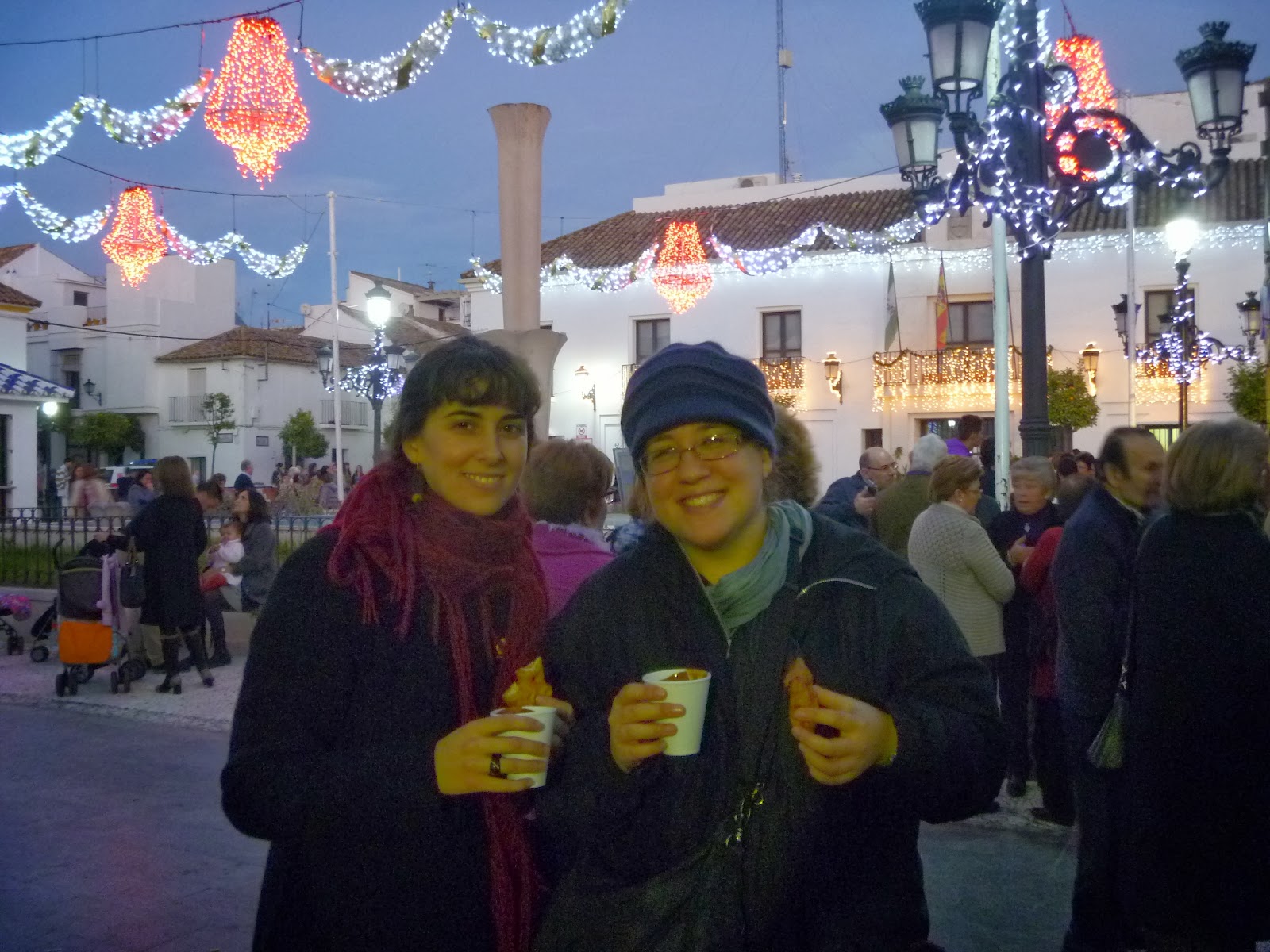
The Christmas season starts more or less officially in Spain during the first week of December, specifically at Candelaria on December 8. Around that time, Christmas lights and other decorations go up throughout the country, from the most elaborate in Madrid to the most simple in tiny Huelva villages. In my five Spanish Christmases, I have concluded that Christmas lights in Spain are of a very specific style. Unlike in the US, where strings of white or multicolored lights and tacky neon reindeer rule, Spanish lights are hung from cables that crisscross streets and boulevards, creating bold, blocky patterns or loop-de-loops that are very distinct from the American-style.


Typical Christmas lights hang on a street in Cadiz
The hanging of lights is often accompanied by installation of a Christmas market in the town square or one of the city plazas. Although Christmas trees are becoming more popular as American and British traditions trickle into Spain, most families still have a carefully-constructed nativity scene in their living rooms to mark the season-- in Andalucia in particular, these can grow to enormous sizes. People devote huge amounts of time and effort to constructing entire tiny Bethlehems, many of which include water features, electric lights, and timed sunrises and sunsets. In Linares, the government sponsored an enormous nativity scene that took up an entire empty store on the shopping street. Given the centrality of the nativity scene, the Christmas markets usually boast a section devoted entirely to selling tiny ceramic wise men, camels, or angels; they also offer decent amount of schlock and, if you're lucky, some respectable arts and crafts. Last year I bought a gorgeous handmade stool crafted from a whole olive-tree stump for 10 euros.

The nativity scene at my school in Talavera de la Reina
    
Traditional Christmastime food differs according to region, but one particular favorite of mine can be found throughout the country: mantecados and polvorónes. Stay with me for a moment here: much like the famous square-rectangle conundrum, polvorónes are mantecados, but not all mantecados are  polvorónes (the difference has to do with the specific recipe.) The nonetheless similar sweets are a sort of crumbly shortbread originally introduced by the Moors (ironic, yes?) Interesting fact: later on, the key ingredient was switched to pork fat, and the Inquisition forced detainees to eat the sweets in order to ferret out secret Muslims and Jews (manteca is pork lard in Spanish.) These days, mantecados and polvorónes are most popular in Andalucia but can be found almost literally everywhere during December. They are extremely delicious and terrible for you.

Christmas sweets. The paper-wrapped sweet on the lower right is a mantecado; the foil wrappers are polvorónes and the others are marzipan and candied fruit from Aragon, two other traditional Christmas treats
Christmas anticipation runs up to December 24, also known as nochebuena (the "good night"). Spanish families all over the country gather to eat Christmas dinner starting around 10:30 or 11 and finishing, in leisurely fashion, after midnight. Except in Catalonia (more on that in the next entry), no gifts are exchanged, but the meal is generally of many courses and includes extended family that has come from all over to eat together. After the last of the flan is finished off, everyone goes out for the night-- nochebuena is known as one of the most raucous "nights out" in the entire year. The bars are filled with people of all ages well into the next morning, when many people like to partake in chocolate con churros. This past year, when I spent Christmas in the white towns of Cadiz, we started our night out at 1 AM. I took a nap around 3:30 and my friend Maria woke me at 4:45, when we left to continue the party at a friend's country house. There, festivities (including Christmas carol singing, listening to Spanish metal, and drinking red wine with Coca-cola) continued until 8:30 AM. Needless to say, I didn't last that long.

The next morning, when the entire village/city has dragged itself out of bed to drink an espresso and attempt to recover... still Christmas is not over. In Spanish, people refer to "navidades" in plural, and my personal theory is that this is because it is refers more to a "Christmas season" than a single day. Besides Christmas Eve and Day the term also refers to New Year's Eve (nochevieja or "old night"-- no one has ever explained to me why it's called that)  and 3 Kings Day.  New Year's Eve is celebrated much the same as its Christmas counterpart, with a multi-course all-family meal that lasts until the wee hours. The major difference is a pause at midnight: as the clock strikes 12, families all over Spain endeavor to eat one grape in tandem with each strike of the cathedral clock-- a challenging task, as the grapes here generally have seeds. I'll let my roommate, Judith, explain to you what an impossible task that is: "Every year I try, and every year I end up like a hamster with my cheeks full of grapes, wishing everyone 'Happy New Year'-- and my parents say, 'Judith, don't talk with your mouth full,'" she explained to me cheerfully earlier this month, as we caught up on our Christmas vacations.


Christmas in the white villages of Cadiz; hot chocolate in the town square of Prado del Rey
  
And yet, even with the grape ordeal in the past, Navidades is not yet complete-- not until January 6 and the arrival of the Reyes Magos (the figures that Americans know as the three Wise Men but whose names are frequently translated here as the "Magic Kings.") Although Santa Claus has made an appearance in Spanish pop culture in recent years, he is not the beloved bringer of presents that he is elsewhere. Spanish children must wait until the morning of January 6 to see what the three Kings of biblical lore (you know, they followed the star to Bethlehem, or something? Don't ask me, I'm a Jew) brought them. The "Dia de Los Reyes Magos,"  full of presents and -- you guessed it-- another multi-generational multi-course meal, is preceded on the evening of January 5 by the "cabalgata de reyes magos," an elaborate procession-cum-parade through the streets announcing the arrival of the Kings. Virtually every community in the country, from the smallest town to the largest metropolis, hosts its own cabalgata, usually featuring Disney characters with oversized heads, some of whom arrive on horseback. The cabalgata in Madrid is largely agreed to be the most impressive, including a great many floats; public opinion generally has it that the quality of other cabalgatas has waned dramatically throughout the country with the onset of the economic crisis. Still, crisis or no, the cabalgata is a must for every under-15 child in town, seeing as every parade includes some frankly intense levels of candy throwing. I know of children who bring umbrellas to turn upside down in order to catch a maximum quantity of sweets. 

From there, I guess you can imagine the rest. Keyed up children, zooming around the house powered by candy overdose; comatose post-sugar crash kids heading sleepily to bed; those same tykes waking at an ungodly hour to see what the Kings have brought (this year they brought me my very own marker/crayon/colored pencil set, complete with pencil case-- there is so much coloring in my future!). And then, once the presents have been opened, the three-course lunch consumed, the last drop of coffee drunk... only then is navidades finished...

... until the next day, when rebajas (enormous city-wide after-Christmas sales) begin, of course.

Christmas lights by the ancient wall in Talavera. I am unsure what special effect I accidentally engaged to make them twinkle like that, but I don't mind. I kind of like it.

Tuesday, December 3, 2013

Strange Fruit 2

I ended the last entry in this series with a note about a pet peeve-- the infuriating and ubiquitous Spanish bar napkin. So I'll start with another one for this second edition of "Weird Things Spanish People Do That You Probably Didn't Know About."

1) They leave dog poop in the middle of the sidewalk
Obviously, this is a problem in the US, too, and in other countries. But as someone who is hoping to hit 41 countries by the end of this year, I can say that I have never been anywhere where the dog poop situation is quite so bad. My theory is that this problem is due to a lack of green space or bushes (for disposal) and a culture of impunity. Spaniards leave poop everywhere. The river walk in Talavera along the Rio Tajo is like a damn obstacle course. I can't count the number of times during my stay in Spain that I was walking along looking at the scenery -- wrought iron balconies over windows in sugary colors, charming side streets under stone arches-- or even just looking at a map and ... SQUISH. Ugh. It's true that laws exist against such practices, but they are poorly enforced. Gross.

The famous balconies of Madrid. But don't get too distracted...

2)  They say completely meaningless things to fill the silence
While it's true this kind of phrase exists in every language,  the phrase "bueno, pues nada" (which translates directly to "Okay, well... nothing") is surprisingly ubiquitous. It usually pops up at the end of a conversation, when things have more or less finished up and neither party has anything left to say. Where an American would probably stay mum and look around awkwardly (and, let's be honest, pretend to text a friend), a Spanish person is more likely to pull out this bad boy. The phrase is a good indicator that the conversation is now finished; the equivalent of "So, uh... yeah." It is a placeholder. It literally serves no other use.

3) They narrate their actions
This is something specifically that I've noticed since my arrival in Talavera. Maribel, one of my co-teachers here, often will come into the staff room Morgan-Freeman style (that is, doing voice over for her life.) "I'm going to wash my hands," she'll announce to no one in particular. Then; "Well, I guess I'll go upstairs." Similarly, my roomate, Judith, would never dare going to sleep without announcing: "I'm going to bed! Goodnight!"

I'll admit it, my American reaction is: '...So? Why are you telling me? What do I care?' But when I asked Judith about this habit, she explained that it's about being polite. If Maribel merely walked into the staffroom without saying anything, it would be like not acknowledging my presence; similarly, if Judith went to bed without telling me it would be an indication of bad blood between us.

Spaniards: human news tickers


4) They mean something totally different than Americans/British people do when they say "Let's meet this morning" or "I'll talk to you this afternoon" 
You probably know that Spanish people eat on an entirely different schedule than Americans/Brits/most of the non-Mediterranean Western world. Lunch is between 2 and 3; dinner is between 9 and 10:30. What you probably didn't know, however is that the eating schedule affects the working definition of "morning" and "afternoon." One is permitted to say "Buenos dias" until 2 pm and "Buenas tardes" until 8 or 9. Thus, I offer you the following tip when making plans with a Spaniard: keep in mind that meeting "this afternoon" means that any time between 3:30 and 8 is up for grabs. This can be especially confusing when talking to a Spaniard in English. He or she may say "I am only free this morning," and although the language is English, the idea of morning is still Spanish-- leaving lots of potential for misunderstanding.

5) They eat bread with EVERYTHING
Seriously, everything. My favorite story to tell about this habit takes place in Santander, with a couchsurfing host.We were preparing lunch from some leftovers: tortilla de patatas (kind of a quiche with potatoes inside) and arroz a la cubana (rice with peas and meat), plus some pasta we made to finish the meal off. There, amongst this cornucopia of carbohydrates, my host exclaimed in horror, "Oh my God, I'm so sorry! I forgot the bread!" Needless to say, I did not mind.

The classic "tortilla" with potatoes ... and bread

Bonus:
From what I can tell, this only applies to Manchegos, people born in Castilla la Mancha, where I live this year. When asked a question they don't have an answer for, instead of saying "Yo no sé" (I don't know), they say: "Yo qué sé?"-- "What do I know?" I don't know what it is about that little difference that gets me, but I always enjoy walking around and overhearing people say "What do I know?" What, indeed, do any of us know? That's deep, Castilla la Mancha. That's deep.

Tuesday, October 22, 2013

Strange Fruit, 1

A barman at his station in Cadiz
After two and a half years living in a foreign country, the idea of what is "normal" has redefined itself many times over. The strange quirks that jumped out at me so dramatically when I first arrived now seem obvious. It's easy to forget that I ever didn't know that a long weekend is called a "puente"--or bridge-- because it often connects a legitimate holiday with the weekend, taking innocent days with it. And it comes as second nature that I have to think about what time I take out the trash because if a policeman saw me bring it out before 8 PM I could get fined. Although it takes some effort to return to that everything-is-new state of mind, I've been meaning to post some observations for awhile, so I'll do my best.

Thus, I present to you: 4 Strange Things Spaniards Do (That You Probably Didn't Know About.)  And if you enjoy these, I'll post four more next week, as well!

1) They say goodbye instead of hello
I've written about this before in a different form, so it makes a good place to start. One of the first things I noticed when I arrived in Palencia two years ago was my neighbors' insistence on saying "Buenos dias (good morning)/"Buenas tardes (good afternoon)" and "hasta luego" (see you later) during our brief interactions in the elevator. It struck me as very odd, since American elevator etiquette relieves the rider from interacting with his/her riding companions at all. Why, I thought, waste the energy to greet someone, only to have to say goodbye to them 15 seconds later? (Plus, I found the Spanish way of saying "Hasta luego", which seems to elide multiple syllables into the linguistic ether, endlessly mysterious.) I was told, however, that not acknowledging one's companions in elevator travel would be a serious insult. Greetings are of tantamount importance here.
The strangeness only grew over the years: during walks in the evening paseo, I heard neighbors greeting each other, and once in awhile instead of hello's I heard instead "Hasta luego!" It seemed very strange that a person would start an interaction with someone by saying "See you later!", but after my previous assumptions I kept this thought to myself-- until I started to hear it more and more after I arrived in Talavera. Finally, I brought the topic up with my roommate. She looked at me like I was crazy. "Why would you open up a conversation with someone if you had neither the time nor intention of talking with them?" she asked me. "This way, we're saying 'Yes, I've seen you, but I don't have time to stop. We'll talk later, another time.'" I admit that this is a much more sensible explanation than I was expecting.

2) They tell strangers 'bon appetit'
Spaniards eager to improve their English often ask me what Americans say to each other before they eat. I am forced then to explain the awkward fact that we don't have any special phrase-- that, in fact, we stole the French phrase 'bon appetit' for the purpose (and that, actually, we stole a lot from the French... and the Germans and the Greeks and so on). 
 This is often confusing to them because the phrase "buen provecho" is an important part of Spanish etiquette, and it's hard for them to imagine a language that doesn't have its own version. Here, one says "buen provecho" before eating with friends or coworkers (usually in more formal settings), the same way one might use "bon appetit" in the US. But the big difference is that some people also say it to anyone they see eating, even strangers. They see it as a breach of etiquette not to do so. 
How seriously do they take this etiquette, you ask? Let's take Saturday a few weeks ago as an example. Hannah came to visit me from Jaen, and I took her to the monthly medieval-style market that takes place along the ancient walls here. (Did I mention that Talavera has 800-year-old Moorish walls? Cool, right?) We bought hunks of empanada, pastry stuffed with meat and veggies, and took them down to the river to eat by the Roman bridge (which is actually a Moorish copy of an earlier Roman bridge. Double cool!), while watching the water birds fly by. As we were tucking in, a bicycle came whizzing down the path in front of us. We barely had time to register his blur zooming past us before he was gone, with merely the call of "Buen provecho!" to let us know we hadn't imagined him.
So: really seriously.


The "Roman" bridge, Talavera

3) They continually use napkins that don't actually work
 Spanish bars are a nationwide gem: of this there is no doubt. On any corner in any Spanish city or town you can find one: a little counter, tucked in a corner, shabby but clean; a polished espresso machine, buzzing and whirring; a beer or cider tap flowing at all hours of the morning and evening; and a small TV playing a talk show, bullfight, or soccer game in the corner. There's always an old guy in a great hat having a beer (even at 11 AM); there's usually a leg of ham, half decimated, by the cold tapas display. Depending on the region, the walls are full of Basque slogans, hung with Real Madrid posters, or decorated with elaborately-painted tiles. And there are always, always napkins in polished chrome holders-- napkins which sully the good name of Spanish bars; napkins that defy logic and even, it seems occasionally, the laws of physics.
For the truth is that these napkins seem specially formulated not to actually do anything. Pulling one out of the dispenser, they always seem unobtrusive enough. They usually say something like "Thank you for your visit" on them; they're of normal size and close-to-normal texture. AND YET. Try to do something napkin-like with them, such as wipe off your hands after a gooey chicken wing or sop up a puddle of spilled beer... and you will somehow find yourself somehow messier than before, the napkin seemingly untouched. They are the scourge of the Spanish bar because of their low level of evil: they are just unobtrusive enough that after this particular instance you will forget all about your hatred of them... until, yet again, you find yourself helpless against an olive oil spot on your sleeve. They are everywhere, in literally every bar in this country, which means that people persist in buying and using them. I am baffled. BAFFLED, I tell you.

4) They throw napkins on the floor of perfectly respectable bars and restaurants
Oh, and another thing about napkins. A traveler walking into a Spanish bar (as described above) might be confused and disgusted to find the floor littered with crumpled paper. Fear not, however: actually, this is a good sign. Traditionally, throwing one's napkin on the floor of a bar has been a compliment, a way to show one's approval of the food. In fact, when I went to a famous Madrid tapas bar last year to write a story for GoMadrid (which you can find here), the owner told me that during the restaurant's golden age they used to employ people whose sole job was to sweep crumpled napkins and shrimp tails off the floor every 20 minutes. That means that, at least in theory, the more napkins on the floor of a bar, the better you can expect the food to be. Or, you know... maybe it's just a really dirty bar.
 (If I'm honest, the feeling of finishing up a tapa-- a nice piece of cheese and bread or some grilled pork in rich, savory sauce-- and throwing my napkin on the ground is thrilling in some small way. Plus, it's a chance to put those damned napkins in their place.)


Friday, October 12, 2012

The Bad Times

The last you heard of me was mid-July, en route home for a much-needed vacation. Really, you hadn't heard much of me before that, either. The last true update came from the end of June, a lovely span of time for teaching, relaxation, exploration, and enjoyment of a Palencia summer just starting to show its most beautiful blossom.

Except that then it all went to hell.

There are very few travel blogs (or at least very few I've read) that address the darker side of travel. It makes sense, of course. Unpleasant travel experiences are negative enough the first time around for the people living through them-- why would a traveler want to subject him or herself, or his/her audience, to a review?

But bad experiences, and even bad streaks, are of course a very real part of traveling. Buses are delayed, plans fall through, weather changes for the worse, important items are stolen, sickness pounces. Hell, just off the top of my head, drawing from my own experiences I can think of, I've: dropped my camera in the English Channel off the coast of Cornwall, got dysentery in Nujiang (Yunnan) during my thesis research, accidentally offended the Muslim sensibilities of my Palestinian host in Jordan, showed up late at night in a tiny Normandy town in the pouring rain and no host in sight for more than an hour, and (most infamously) spent four hideously cramped, hot days shuttling around the hellish North Indian bus system, from one incorrect town to the next.

So: July 2012. I had been hired to work in a summer camp in Cantabria, in the Spanish northern interior, for the last two weeks of July. I decided to give up my Palencia apartment on the first of the month in order to use my rent money to travel. I planned a beach-and-culture vacation across Asturias, Cantabria, and Basque Country (Pais Vasco). I spent a desperate several days packing up my apartment and departed for Oviedo, where I had exactly one day to enjoy my new Asturian surroundings when the proverbial first shoe dropped: the director called me bright on Sunday morning, while I picked through antiques and cheap clothing at the market, and told me that the camp had been suddenly and unceremoniously cancelled. I found myself suddenly out 500 euros (more, really, given how much extra I'd paid for a flight home that coincided with the camp schedule) and homeless for the next month.

I spent the next day panicking, then decided to plow ahead with my couchsurfing adventure along the Cantabrian Sea/Bay of Biscay. Unfortunately, the sudden implosion of my summer plans was just a preview of the way things would go until my departure for the US. Just within the ensuing 2.5 weeks I suffered through bad weather (unseasonably cold and wet even for usually cold and wet Asturias), suddenly unavailable hotels or hosts, a brief bout with fleas or bedbugs in the hostels I shared with pilgrims on the northern Camino de Santiago, a sprained ankle, a stolen credit card, and general loneliness and increasing discouragement.

It was an incredibly stressful period that sometimes felt unending-- just when I was recovering from one physical or emotional setback, another seemed to be on the way. But despite all that the bright spots were intensely bright. I slipped in a peaceful beach weekend in tiny Luanco (just before I slipped again, this time on rain-slicked cobbles and suffered the aforementioned ankle injury.) I marveled at the stunning Llanes cliff-and-ocean vistas (before fog descended and obscured them completely.) On July 4, I purchased digestive cookies, chocolate, and a bag of the weirdly-chewy-pink-and-white creation that pass for a Spanish marshmallows and taught my couchsurfing host to make s'mores using tea light candles. I used some of my extra time in Basque Country to eat my weight in delicious Basque pintxos (incredibly intricate mini-meals) and hike an unbelievably scenic seaside monastery, balanced precariously on top of dramatic sea cliffs. I was determined to surmount my itching legs, lost money, illness, and anxiety. It got a lot easier to do that after one evening in particular, which changed my perspective on "the bad times" of travel.

I didn't mean to spend as long in Ribadesella as long as I eventually stayed. I'd traveled through with my parents during their Easter visit-- we'd wanted to visit the 25, 000 year old cave paintings there but, due to bad weather and timing miscalculations, missed our appointment. I had resolved to return, and return I did. But, as sometimes happens with nomadic travel, I seemed to be caught in some strange magnetic storm around the town, and I couldn't seem to leave. I saw the paintings (which were breathtaking, especially one particular 10, 000 year old horse's head that looked like it had been scrawled the day before), then went to the previously discussed July 4th celebration in a nearby town.  I came back, then left again to go to a cider festival (where it rained all day, I missed the major festivities due to train schedules, and my host had to suddenly cancel on me). Another return-- this time to attempt a canoe trip which was unpleasantly rained out. An ill-fated hostel misadventure later, I decided it was worth it to stay around for the town's Patron Saint celebrations.

I was feeling decidedly fed up, I'll admit it. The rain was unremitting, and I was disappointed about my cancelled canoeing trip and stressed about finding somewhere to stay in my next stop and how to stretch the money I had left to fill the time until my flight home. Tempted to pout in my hostel, I instead walked across the narrow bridge over the mouth of the river and joined in the festivities. The rain slowed to a trickle, and the statue of the Saint, Maria Magdalena, was carried out of its shrine on the shoulders of priests, follow by a line of solemn musicians playing an Asturian instrument heavily reminiscent of bagpipes.

Most patron saint festivals include a parade through town, but Ribadesella is a fishing port, and the citizens choose to honor their saint in their own way. I watched in the watery twilight as Maria Magdalena was placed carefully in a fishing boat, festooned with flags and flowers and filled with adoring locals. A second boat held the bagpipers, and the two led a solemn parade of at least 60 boats (pleasurecraft, fishing rigs, and local police/navy alike) out into the open ocean, where a bouquet of flowers was tossed into the water in honor of fishermen lost over the year.

Santa Maria Magdalena starts her voyage into the Cantabrian Sea outside Ribadesella

The maritime parade ended with a brief terrestrial procession to the saint's shrine, where the crowd paused to sing a hymn to her. The shrine was at the edge of the carnival portion of the festival, so the harmonies of voices raised in song mingled with the beeps and booms of the spinning tea cups and bumper cars, while the saint's halo was set aglow by the oranges and greens of neon lights from the Ferris wheel. I wiped the fog from my glasses and took a moment to appreciate this beautiful intermingling of old and new traditions, writ small in the few moments the Saint spent raised against the sky. A string of bad luck and a bad attitude couldn't take that away from me, and that knowledge carried me through the bad times to come, all the way back to the US.

You might ask why I've waited until now to tell you about this. It's mid-October now, and Maria Magdalena has been resting in her shrine for almost 3 months. In between, I spent almost seven weeks recharging my batteries and reconnecting with my family, friends, and beloved city, then returned to Spain for my second year on the Iberian peninsula.

Well, the Bad Times come in many forms-- that's the short answer to "Why now?" Of course I remember having a difficult time getting used to Palencia last year, but I'm willing to entertain the possibility that 8 months of subsequent happiness have colored those initial times a bit rosier than than they really were.

I'm living in Andalucia this year, in a small town called Linares--more on that soon--and I'll be honest with you: my first few weeks here have been pretty difficult. The language is spoken differently here, and everything is even newer and more overwhelming than I anticipated. New friends are hard to come by, the apartment hunting process was much more difficult than I had hoped, my new apartment is presenting several stubborn issues, and I am struggling with my expectations and hopes for this year and the D word (disappointment. More on that later, too.)

But last night one of my first Linares friends, a gym teacher at the elementary school where I am working, took me to a local "feria" (what patron saint festivals are called here in the south.) In a small, out-of-the-way plaza crowned by palm trees, an enthusiastic rock band pumped out covers by the likes of KISS and The Cranberries, while under a white tent neighbors drank beer and ate tapas together. The lead singer launched into an impressive version of "Zombie," and I watched grandmothers and grandfathers nod along in rhythm with a group of faux-bored teenagers perched on the fence off to the side. The tang of roasting meat and fresh beer floated on the breeze, and a motley crew of parents and children and twenty-somethings swayed with their hands in the air, caught up in the music.

For a minute I forgot my anxieties and remembered, instead, that night in Ribadesella and the potential for the bad times to be... not so bad after all.

Wednesday, June 6, 2012

Palabras para Julia

A few days ago I posted the following informal poll to my friends on Facebook:

"So I would say that at least once every two days I have an "Oh God what am I doing with my life where am I going who am I?" moment.
Survey: would you guys say that is above or below average?"


The responses I got were encouraging-- an assortment of friends of different ages and from different parts of my life assuring me that they felt the same way, that it was a condition of being in one's 20s, or even just a condition of being human. One friend currently living in Korea wrote, "The thoughts still occur in your 30's, even more so because of being an expat I think." 

I'm inclined to agree. Of course, being in one's 20s encourages feelings of being unsure, unmoored, and afraid, but I think those feelings are magnified by stepping so far away, metaphorically and physically, from what society says we are "supposed" to be doing. I admit that as I watch friends and acquaintances from afar--as they work 9-5 office jobs, whether fascinating or mundane; decorate apartments; get engaged; buy houses-- I find that all that is not without its magnetism. Even days like today, walking down Calle Mayor on a warm evening during paseo, listening to Ace of Base and trying not to burst into a dance party for one in public just for the familiar and exotic and beloved beauty of it all...I still feel that pull, to go home to the familiar, to stop missing out on that world turning at home without me, to start my "real" life (hell, to figure out what that "real life" entails.) It's what I've been taught to want, and the part of me that really wants it is terrified by my choice to stay. (More on that soon.)

...Which brings me to my Spanish final exam last Friday. I am confident enough to say I passed it, although the listening comprehension was much more difficult for me this time around. I am happy to report as well that I wrote my first opinion essay in Spanish, and it felt completely badass. The exam included something I never expected, however. Our second reading comprehension assignment included a very sweet letter from a fictional father to a daughter having a difficult time living abroad. "It's hard, I know, but you will see how these moments of solitude can also teach you many important things. It's something no one can learn for you," he writes. Who knew I'd ever find myself sniffing away tears during a language exam?

This fictional father goes on to quote a poem from a very real Spanish poet, Jose Agustin Goytisolo, a poem which spoke to me, as well. I want to include it here, although I've cut portions (as the version that so touched me was edited as well, although I didn't know it then.) I'll include the Spanish first, and then my own translation.

PALABRAS PARA JULIA 
Tú no puedes volver atrás
porque la vida ya te empuja
como un aullido interminable.
Hija mía es mejor vivir
con la alegría de los hombres
que llorar ante el muro ciego.
Te sentirás acorralada
te sentirás perdida o sola
tal vez querrás no haber nacido...
Nunca te entregues ni te apartes
junto al camino, nunca digas
no puedo más y aquí me quedo.
La vida es bella, tú verás
como a pesar de los pesares
tendrás amor, tendrás amigos...
Y siempre siempre acuérdate
de lo que un día yo escribí
pensando en ti como ahora pienso

Now, my poor translation:


WORDS FOR JULIA
You cannot go back
because life already pushes you
as an endless wail.
My daughter, it is better to live with the joy of men
then to mourn behind the blind wall.
You will feel cornered,
you will feel lost or alone.
Maybe you will wish you were never born.
Never give in or swerve
away from the road, never say
I can't anymore, I stay here.
Life is beautiful, you will see
how in spite of everything 
you will have love, you will have friends...
 and always, always remember
what I wrote to you one day
thinking of you the way I think now.


I don't now what it is about this poem. The words are plain, the rhythm is basic, there's no rhyme or imagery. But for me the message, sweet and powerful, is enough-- like one more voice in my informal poll encouraging me to keep searching for what's next.

Monday, May 28, 2012

Did you know? Spain tidbits, pt 1

It's hard to believe that I've now been living in Spain almost nine months. If we lived in a world where countries and people could create life, I would be giving birth any moment now. And every day has brought a surprise, a new vocabulary word, and interesting culture observation. While some of them have been (and will be) worth their own blog entries, others are worth a passing mention. I've compiled a few noteworthy tidbits here; you can expect more in other entries of this type in the future.

1) Punk rock grandmas
In the United States, dying one's hair is certainly not an uncommon practice, but most people limit their chosen hue to shades naturally found on heads around the world (if not their own particular strands.) Those individuals choosing more dramatic blues, greens, or pinks are generally understood to be making a Statement. Sure, those statements may vary, but the general message is the same: defiance and exclamation. Look at me-- see that I am different than you are.

It was thus with some confusion that I noticed women, mostly older women, walking around Palencia with magenta hair. Some of them had dyed their entire heads; others merely had a few vivid streaks--but it all seemed to be the same shade, almost as if they were sharing the bottle. This was something different than the "blue tint" effect occasionally seen in the US among senior citizens. It was clearly a purposeful, bold (in both senses of the word) choice.

Later on, I'd travel to northern Spain, to Basque country, and see many older women with similarly dyed hair, although this time with aqua/turquoise/blue hues. Nobody gives them a second look, neither in Palencia nor up north. Here it seems to be just another way to deal with graying hair and the aging process in general-- and I've decided I like it a lot.

2) Hellogoodbye
Like English (or, I imagine, most languages), Spanish has a cornucopia of various expressions for use in greetings. They differ based on the intimacy or mood of the speakers, the time of day, and the country (or in this case part of Spain) where they're greeting each other. This in itself is not remarkable.

However, after a month in Palencia, once I had moved into my own apartment, I started to notice something odd. Whenever my roommate came in to the apartment she said, "Hola." Without fail, when she left she called out, "Hasta luego!" even if we hadn't spoken in between. [A note on "Hasta luego" (which means "see you later) in Castilla y Leon: This phrase is constantly used, but the syllables rarely all appear together. The Palentino 'Hasta luego' is slurred together so quickly that you almost don't hear the first word at all. Try as I might, I haven't been able to successfully recreate it.]

But I digress. After I noticed my roommate's behavior, I started to see parallels in the behavior of others in my apartment building. Often when we crossed paths at the mailbox or in the doorway they would greet me with a friendly "Buenos dias" or "Muy buenas." They always followed this up with the famous Palentino "Ha-luego." Even in the elevator, I would be greeted, thirty seconds of elevator silence would ensue--and then, there it was again, the departing greeting. In the end, I remain puzzled but have concluded that greetings are a more important part of etiquette here than in the US, even among strangers.

3) Out for a walk
I've mentioned the "paseo" in this blog before, but it's worth revisiting. Palencia's Calle Mayor is a scenic pedestrianized mile lined with stores and 19th century buildings. In the winter the wind can be wicked, but the summer finds tin tables and umbrellas set out to enjoy the atmosphere. The street is a strange animal, a chameleon of sorts-- on Sunday afternoons and evenings after 11:30 pm it's virtually a movie set, complete empty and eerily clean (the sanitation department here is admirably diligent.) But there is a period of time every day before dinner (between the hours of 6 and 8, I would say) when Palentinos (and, I think, many northern Spaniards) like to go out for a stroll.

During that time Calle Mayor is teeming, sometimes even choked, with pedestrians. Some walk faster, some saunter. Many older couples hobble arm in arm, some adult children push their parents in wheelchairs, and there are always young kids weaving in and out of the chaos chasing a soccer ball. Everywhere there are clumps of people stopping to chat, young mothers showing off new babies, teenagers flirting and joking, people window shopping and chatting about the day's news. Sometimes there are balloon sellers; in the winter a series of wooden shacks appeared selling hot fresh mini-donuts and roasted chestnuts. It's Palentino life in a two-hour nutshell, and although I dread the thought of biking anywhere during that time (an experience like nothing more than a first-person video game), the feeling of walking the street during paseo--idly watching people, catching snatches of conversation, and feeling the energy of so many people ricocheting off the high pastel buildings--remains one of my favorites from my time here.

Saturday, May 12, 2012

Habeis ganado? Que si, hombre

Almost nine months ago, we auxiliars-to-be sat in an airless, windowless room in Madrid talking to one of the American consuls. She was speaking about safety, urging us to be careful of muggings and pickpockets. "But," she added, almost as an afterthought, "there's something you have to understand about Spanish people. To them, the street is an extension of the living room, and they treat it as such. You need to be careful, of course, and sensible. But help is never far away on the Spanish streets."

When I first arrived here almost nine months ago, I think I was too busy in my head to really see the miracle that is Spanish summer. By the time I had adjusted and settled in, the days were ending earlier and the trees bending over the Rio Carrion were tinting yellow. Outdoor tables at cafes were stacked and put away; the fog of winter (both bone-chillingly literal and metaphorical) obscured what had come before.

And then, to be honest, the weather this spring hasn't been ideal, either. After the driest winter in 70 years, we had several weeks straight of cold, raw, rainy unpleasantness. We powered through a wet Semana Santa and still managed to enjoy it (posts forthcoming), but I admit it put a damper on this last month or so.

And then suddenly this week--summer, and I understood finally what she had meant.

The heat arrived a few days ago, without any real warning or transition, and it happened to coincide with a very important soccer game, the championship of the European League. I've never been much for soccer, but the electric atmosphere combined with the sudden warmth of the air to create something remarkable. Tin tables and chairs sprouted like mushrooms and the streets were choked with the chatting and strolling multitudes. At game time, children chased soccer balls of their own in the main square while muffled roars sounded from the surrounding bars. I sat with friends and savored the first outdoor beer of the season, then walked down the deserted main street listening to the game's aftermath. We passed a couple of celebrating fans in striped red-and-white jerseys. "Habeis ganado?" we asked them-- "Did you guys win?" "Que si, hombre," the taller one yelled over his shoulder. "Obviously!"

We turned the corner and passed a similarly exuberant bar, festooned with red and white cloth and team flags, spilling warm yellow light into the street. Through the window I could see a cluster of men packing food into plastic containers to bring home. Outside, by the window, three grandmother types played cards and sipped beer. I looked at my watch: 12:30 am. The week before, the streets had been empty, reflecting moonlight in freezing puddles. Now it was like these women had always been here; like they had never been cold in their lives.

The heat continues as I write this, and our sudden summer is calling for a shift in schedule. Already things feel lazier, more relaxed... and they are definitely pushed later. It's this change (along with the retaking of the streets) that's made me feel in the last few days that everything is falling into place. Chatting with my roommate over lunch, greeting acquaintances in the grocery store or at the park, enjoying the late night warmth--I feel like I've finally found my rhythm.  I'm a notorious night owl, and it's thrilling to sit in air as warm as bathwater with a group of friends drinking a beer, surrounded by a crowd so robust that the waiter has to tell us any food we order will take an hour to arrive. The night is dark, thick, hot, ringing with the clink of glasses and jostling cutlery. There are sleepy children eating ice cream and older couples walking arm-in-arm. In the United States any of these people would be snug, safe and sound in their beds. But here in Palencia, it's 1 AM and summer has arrived.


Tuesday, March 13, 2012

Tuesday the 13th

Did you know that the concept of "Friday the 13th" doesn't exist in Spain? Instead, the unlucky day is Tuesday the 13th (also known as today.) I'm told the Friday-Tuesday switch has to do with Tuesday's association in many languages with Ares/Mars, the god of war (in Spanish, Tuesday is Martes.) Also, the fall of Constantinople happened on a Tuesday, which explains why the Greeks aren't so wild about it, either.

Anyway, despite the anxieties of various Spanish friends, I am happy to report that nothing untoward happened to me today (and it's 11:42 PM, so I'm hoping I can get off scot-free saying that. If no one hears from me in the next 48 hours, send out a search party armed with four leaf clovers and pennies picked up from the sidewalk.)

Monday, March 5, 2012

Fun with Spanish, 1: At the beach

While I've focused generally on cultural adventures in this blog, the truth is that language is culture. There's a great deal to be learned about a country or a people through its language. It's true that I go to Spanish classes two to three times a week at the Escuela Oficial de Idiomas (Official Language School), but my real classroom is in Calle Mayor, in the bars and theaters of this city, in the grocery stores and train stations and in the new friendships I've made. So, my thought is to add a new language feature here, mini blog posts to teach you some small Spanish somethings I'm picking up here in my daily life.

Today's iteration has to do with the ocean--well, sort of.

1) Scrambled sea
Let's say you're at the beach on a blazing hot day. Your sailboat-owning friend invites you on a tour around the bay. That sounds good, you say-- but just as you are preparing to depart, a couple of threatening black thunderheads roll in, and a stiff breeze kicks up. You hear peals of thunder, and even the water in the marina is roiling. Going on this boat ride would be a one-way ticket to seasick central. You turn to your friend and say sadly, "El mar está revuelto."

Strictly speaking, you're calling the water "choppy" the way we would in English, unsettled or uneven. The interesting thing here is that the direct translation is "The sea is scrambled"--the same sort of "scrambled" that shows up to describe eggs on bar menus all over Spain, usually accompanied by an assortment of cheeses, chorizo, or mushrooms. No "choppy" equivalents here-- Spaniards prefer a different kitchen metaphor for their seas.

2) Hangover or undertow?
I first learned the word "hangover" from a couple of Columbian students who attended the school where I taught in Boston. "Una resaca" was an all-purpose excuse for them, explaining lateness, distraction, or exhaustion. Las resacas are topics of much discussion here in Spain as well--mostly as a point of pride if one can survive a particularly difficult morning after last night's festivities, or else if one never gets a hangover at all. (These individuals are particularly to be envied by those of us who hangover after half a glass of wine.)

The concept gets linguistically more interesting when you find out that the word for an undertow at a beach is also "una resaca." Not only does it make the age-old admonition not to swim when there's an undertow doubly wise-- it also creates a much more evocative description of the experience of a-morning-after. Who among us hasn't felt like he or she was being sucked into a deep, dark void after a night getting especially friendly with tequila or rum?

Sunday, November 13, 2011

¿No estás aburrida? (part 1)

This question, which translates to "Aren't you bored?", has been sort of the bane of my existence the past six weeks. Or really, longer than that. Ever since I received the news that I would be teaching in Palencia, I've had people (mostly Spaniards) putting on their pitying faces and consoling hats and going to town.

"Oh, it's very pretty," they almost invariably say. "I've never been there. But it's really small. There's not much to see." They don't always say the "A" (or in English "B") word, but they don't have to. It's implied. Here, "small" means "unimportant" and "unimportant" means "empty of interest."
... Okay, to be fair perhaps it's not quite so stark and extreme as all that. But for a lot of Spaniards it seems there's two types of places: big cities, and everything else. And I think you can guess which type is worth your attention.

As I've struggled to make a new life here, I've been dogged by an anxiety that is difficult to place. Even once I found an apartment, moved in, and started work, I felt niggled by something I couldn't name-- until, after a few weeks, I started to discover the city and realized it was boredom I feared. All I saw in terms of socializing and food were a scattering of typical Spanish bars throughout the city. They were atmospheric bars, yes, that showed bullfights, served tapas and local wine, were full of old men playing dominoes. But as someone who possesses a more-than-generous helping of the so-called novelty-seeking gene, that didn't seem like enough to keep me engaged for a year. Yes, enjoying those bars for the first few months would be lovely. But what about after that? What if everyone was right? What if I was going to miserable here, and this was the proof?

I started an almost desperate search to prove them wrong. I examined every passing poster and flyer for events happening in Palencia. Surprisingly, I found a fair amount--plays and concerts at the city's two theaters, a festival of local gastronomy, a nature walk led by the Spanish equivalent of the Parks department. I went to some of those events, with mixed results. A concert by a touring Cuban group, decked out in three-piece suits and bowler hats, was fantastic; a benefit for the local food pantry featuring what can only be described as two land-locked cruiseship singers, not so much. But I was heartened even by the presence of cultural events, of possibilities, of choice. I started to realize that for me, choice on how to spend my time is really important. I didn't like the idea of being boxed into one particular activity for all of my Spanish weekends.

The next weekend, I found out that a small bar by the manicured park that cuts the city in half hosts live rock music every weekend. After that came an "alternative" pub with salsa and rap acts; a karaoke/bowling joint with comedy acts on Tuesdays; and a restaurant famous for its filthy floors and tasty, cheap food. And I felt something change--my search for interesting Palencia adventures was no less thorough, but its mood had altered. I found that as long as I knew that there were fun things out there for me to discover, I enjoyed the act of discovering them. Prior to moving to Spain, I had written to a friend that I was looking forward to "getting under the skin" of a city--that had been a big part of whatt I've referred to here as my "stale" expat dream. Well, this was what "getting under the skin" felt like... and I was enjoying it.

I paced myself, trying out a new bar or exploring at a new street, signing up for a dance class, or going to a new concert, once or twice every week. I was (and am) aware that Palencia, while rich with interesting options, is not by any means an infinite city, but I liked mixing newness with the start to a routine, a list of fun places I could frequent if I liked. Sometimes I traveled around the province, or even farther afield (posts about my trips to Madrid and to Galicia, a province in the northwest, are coming). And I didn't feel bored. At least not yet.

Honestly, that's been the worst part of it. The initial fear has mostly been dispelled, but the endless discussion of the "b" word with Spaniards (most often Palentinos themselves!) has not ceased. I'm sure this city is not a cornucopia of fascination for people who've lived here their entire lives, but I haven't--so for me it's an honor and a pleasure to learn about everyday Spanish life and make one of my own here.

My big realization has been that I fear the conversation more than the reality-- so I admit that "Aren't you bored?" and its other question compatriots still niggle. We start down that road, and I feel myself beginning to wonder and to worry. I wring my hands, imagining myself here in the gray doldrums of February, feeling trapped and miserable. Honestly, these days, I find myself thinking that if people would stop asking me if I'm bored, or if the city is too small, or if I have things to do; if they would just stop talking about how [fill in other city, Barcelona/Burgos/Madrid/Valladolid/Salamanca] would make a much better and more pleasant place to live... I could probably live here more or less happily.

Of course, the question after that is: if the conversations and commentary won't stop, how can I fight them? Steady, persistent rhetoric can be as potent a weapon as water torture. Are my weapons of choice-- determination, curiosity, humor, a sense of adventure--powerful enough to hold back the advancing tides of discontent?

(Next in this series: Some thoughts on the relationship between boredom, travel, and expathood.)